 Michael R. Hicks
This Interview with the Author should also be considered an installment of The Kindle Report.
Michael R. Hicks released his first book, In Her Name, in April of last year, and his second, Publish Your Work on the Amazon Kindle: A Practical Guide seven months later. It is, of course, this second book that has inspired the timing of this interview, fitting appropriately into The Kindle Report series of articles here at PODBRAM. This self-proclaimed computer geek has a degree in Russian, and he spent one summer during his college years studying the language at Leningrad State University in the USSR. Do I have your attention now? After graduating from college and the ROTC program, he began working for the Department of Defense in Maryland, where he still resides today with his wife, two stepsons, and two large Siberian cats. Did I mention that he has been particularly successful at marketing his two POD books?
PODBRAM: Let’s begin by your giving us a little background on your life and writing. Aside from spending a summer in the USSR, you have been quite a traveler, haven’t you?
Michael: Well, I actually hadn't done much traveling until college, although I guess I can claim a suitably unique childhood! I was born in 1963 in Maryland, the only child of an elementary school math teacher (who, ironically enough, had a masters in zoology) and a pathologist and former Navy officer. We lived together with my dad's parents for most of my growing-up years, with the family raising a variety of varmints including Weimaraner dogs and Arabian horses (think Noah's ark without the ark and you'll get the picture). While I was born in Maryland, we moved out west to Arizona about six months later, and that's where I lived until I graduated from Arizona State University in '85 with a bachelor’s in Russian. I was also an Army ROTC grad, completing all four years in my first two years at school, getting my commission in '83 as a military intelligence officer in the Army Reserve. I had an opportunity to spend the next summer studying Russian at Leningrad State University in the USSR, and couldn't pass it up: that was my first time traveling outside the United States, and it was quite a trip!
When I graduated from Arizona State in '85, I got hired by the Department of Defense as an analyst looking at the Big Bad Bear, and have since then worked a variety of jobs in DoD from database project development to management (which is where, alas, I am now). Aside from my junket to the USSR back in the mid-1980s (with a side trip to Finland), I've been to Europe a number of times, visiting various spots in England, Germany (West), and France. I also had the privilege of going on a trip with my parents (who are literally globe-trotting travelers) to central Africa, visiting Kenya, Tanzania, and Rwanda (before the genocide there). My family comprises my wife, Jan - we've been married seven years now - and her two boys (my stepsons) Ben and Samuel. Add on a couple of feisty Siberian cats, and that makes up the home team complement!
PODBRAM: Let me guess: The Hunt for Red October, No Way Out, and Gorky Park are three of your favorite movies, right?
Michael: Oddly enough...no! I really enjoyed Hunt for Red October, and No Way Out was good, but I never even saw Gorky Park and I don't own any of these movies. I enjoy thrillers, including all the Clancy-based movies, through more recent fare such as the Bourne movies and Vantage Point. But, much as I hate to admit it, my favorite movies - those I've bought and will pop into the Blu-Ray player any time the mood strikes - tend toward what might be called fairly cheesy sci-fi sorts of things like Stargate, Independence Day, and Armageddon, just to name a few. Sure, I also enjoy more meaty fare like Master and Commander and Gladiator, along with The Lord of the Rings, Star Wars, Star Trek, and so on. But in terms of the movies I've watched and typically enjoy the most: cheesy sci-fi!
PODBRAM: Some people might expect from your lifestyle and career choices that you might have written in the same genre as Tom Clancy, rather than the SciFi/Fantasy one. What are your thoughts on this concept?
Michael: Based on what I've heard from readers, there are probably a few Clancy-inspired elements sprinkled throughout In Her Name (the original trilogy novel), and probably more in In Her Name: First Contact, the new novel I'm working on now. My two favorite novels by Clancy are actually Red Storm Rising - wish they would have made that into a movie, although the ending was disappointing - and Without Remorse. Despite the military aspect that seems to pop to the fore from my background, as a kid there was a lot of science fiction mixed in. My favorite TV times were Friday nights (at the obscenely late time of 10 p.m.) when one of the local stations would play a sci-fi or horror movie, and then World Beyond, a show that ran at 10 a.m. on Saturdays with all kinds of sci-fi movies. And then there was Star Trek, Space 1999, you name it, I watched it (at least back then). I loved model rockets and followed the space program pretty close back then.So in combination, my writing is probably a lot closer in theme to military science fiction than anything else, but mixes in other elements, too.
PODBRAM: What sort of educational experience do you have, and is it relevant to your writing or the subject matter you have chosen?
Michael: Aside from attending Arizona State University and my training in the Army as a military intelligence officer, I haven't spent much time on formal education. Much of what I've learned over the years has been self-taught, which probably explains why I can't be trusted with power tools! As far as my literary background, I took the minimal requirements for English; most of the literature I've studied has been Russian.So, I don't have a lot in the way of educational credentials that I can wave around to proclaim myself a literary genius. I'm just me.
PODBRAM: What about your work career? How has your choice of profession influenced your writing?
Michael: Well, that's a bit more problematic, since I can't really talk much about my work except to say that I have done - and still do - a lot of writing, although none of it's fiction (despite what my bosses might sometimes say!). A lot of technical writing, project proposals, and personnel evaluations is how I spend most of my day at work. Boo.
PODBRAM: Do you have any hobbies other than writing, publishing, and computers?
Michael: I enjoy reading a great deal (although I always wish I had more time) on my Kindle; watching movies at home and in the theater; kayaking and fishing (the fish just laugh at me, but I enjoy it anyway); and fitness in general (my wife and I are both independent Beachbody coaches). I'm also a certified geek and green guy: we've done just about everything we can to green up our lifestyle, and my wife and I plan on building an earthship after we retire so we can go completely off the grid. After seeing the electric bills go up in the last few years, I can't wait!
PODBRAM: How long have you been writing? Has In Her Name been planned for a long time? Did you expect that your second book would be a Kindle how-to?
Michael: I began In Her Name around 1991, and completed the rough draft in 1994. I shopped it around to several publishers, but didn't get any nibbles. There were some tumultuous things going on in my life at that time, and I shelved the project. It sat under my desk gathering dust until early 2008, when I discovered Amazon's Digital Text Platform publishing process for the Kindle. I figured, "Hey, why not?" and set about getting the book ready for publication, publishing the first iteration in April 2008, following that up with a print version through Lightning Source, Inc. Then, after spending a lot of time on the DTP forums, both learning and helping others, I wrote and published Publish Your Book On The Amazon Kindle: A Practical Guide to help folks get their books onto the Kindle platform. Did I expect my second published book would be a Kindle how-to guide? Not on your life! But I knew that a lot of other folks were having the same troubles as I had gone through, and if I could help them through the process, so much the better. Unlike me, very few authors have a lot of experience with techno-junk like programming, HTML, and computers in general: they want to write, not deal with a bunch of technical agony getting their books published.
PODBRAM: Your genre of choice is obviously science fiction. Who or what were your earliest inspirations in this direction?
Michael: That's a tough one: there were so many! But I think the biggies are clearly Robert Heinlein, Larry Niven, and Jerry Pournelle. If I had to pick two of the most critical works, it would be Starship Troopers by Heinlein and The Mote In God's Eye, by Niven and Pournelle. Starship Troopers was a landmark not so much for the sci-fi aspects, but the sociological commentary Heinlein embedded in it. (Note: this wasn't just glossed over in the movie with the same name, but totally twisted around, in my opinion.) And The Mote In God's Eye is my most-read book, by far. It's some of the best and most imaginative hard sci-fi ever (just my opinion).
PODBRAM: Were you more influenced by books or movies in the science fiction genre?
Michael: I'd have to say books, by a long shot. The sad fact is that there are tons of good sci-fi books out there, but there are pathetically few really good sci-fi movies by comparison. There are some, yes, but the ratio is pretty darn low. While I enjoy the visuals of the movies (the ones that don't stink), good books really work your mind a lot more without letting you know that it's doing any more "work." That's actually one of the things that's a key part of the hero of In Her Name when he was a boy (but no spoilers!).
PODBRAM: What do you think your sci-fi work offers to readers that others do not?
Michael: Based on what readers have said, I think the main thing my work offers, least with the In Her Name series, that's unique is what I guess I'll call a "multi-genre" appeal. Yes, it's got science fiction elements, but it also mixes in things you'd normally see in high fantasy (without using "magic"), some elements that would be at home in a political thriller, and just to round things out, a thread of romance. So it's gotten a lot of positive feedback from sci-fi and fantasy readers, but quite a few folks who don't normally read those sorts of books have really enjoyed it, as well. That's not necessarily going to be the case with all my books (I have some ideas for historical romances, among other things), but it is for the In Her Name series.
PODBRAM: I see that the michaelrhicks.com name has already been claimed by a noted piano composer. Is that why you chose kreelanwarrior.com as your website? Have you experienced any miscommunication issues with your online fans due to the same name?
Michael: Well, funny you should mention that. The short answer is no, I haven't had any connection problems with readers because of that, at least that I've heard about. But here's an interesting anecdote on "my" name: a few years ago I got an email from a guy named Michael Hicks. He sent it to a bunch of other folks, all named Michael Hicks, asking if we wanted to form a "Michael Hicks club”. I think he really needed a hobby! And no, I didn't sign up for the club...
PODBRAM: Your website is named Kreelan Warrior. Could you explain the origins of this title and URL to our readers?
Michael: KreelanWarrior.com is taken from In Her Name. The antagonists in the story are from the Kreelan Empire, an ancient warrior race that's been fighting, and slowly wiping out, the human Confederation. So Kreelan warrior seemed a logical name for the site. Not necessarily the best marketing strategy in the world, perhaps, but there it is!
PODBRAM: My wife and I are the parents of eleven kitties and I have a section on my site called Cat of the Day. I see on your website that you have a page called Funny Cat Videos. Everyone should go look at your videos because they are a hoot! Would you like to tell us about your cats?
Michael: My wife grew up with cats, I grew up with dogs (remember the menagerie?), so I didn't have a natural inclination toward cats. We would have loved to have pets, cats or dogs, but my wife's older son Samuel was very allergic to both. So we reconciled ourselves to never owning pets (since neither of us like reptiles!). But it turns out that Siberian cats are quasi-hypoallergenic, having far less of the protein in their saliva that causes the allergies. After visiting some folks nearby who owned some Siberians, it was clear that it might just work: Samuel had no reaction whatsoever. So, we went to a local breeder and picked out a pair of kittens, Sasha and Nina, brought them home, and the rest is history. They're great fun and very affectionate pets (well, technically we're the pets, since cats are the dominant life form on the planet!), and Samuel hasn't had a bit of trouble with his allergies because of them.
PODBRAM: Did you submit one or more manuscripts to traditional publishers in the beginning, before deciding to join the ranks of self-publishers?
Michael: I submitted In Her Name to several publishers back around 1994, but unsurprisingly, got nothing but rejection letters. Now, to be perfectly honest, I didn't try as hard as I could have, largely because there were a lot of distractions that came up at that point in my life. But there was a lot of frustration in getting the book published, regardless. So I shelved my publishing aspirations for about a dozen years until the Kindle came out and opened up some interesting self-publishing opportunities.
PODBRAM: Have you expended much effort seeking out an agent, and have you had much success in that regard?
Michael: To be honest, no. Part of that is because I'm a hardheaded do-it-yourselfer (although I wouldn't turn down a decent publishing contract!), but part of it is also a question of margins and value added. The publisher is already going to take the lion's share of any profits, and if you add an agent on top of that, there goes more of your birthday cake. As for value added, while I know that some agents add tremendous value, I also know that there are tons of authors who have retained agents and their books still haven't gotten published, even after a few years. Getting published is a lottery, with about the same odds, and finding the "right" agent is part of the lottery process.
PODBRAM: Did you expect to get as involved with electronic books as you have, or did you set out to become a POD author?
Michael: I had no idea what "POD" meant when I first started getting In Her Name ready for publication for the Kindle and, shortly thereafter, Mobipocket. My goal was simply to get In Her Name published, because that was one of the things that I wanted to say that I'd done in my lifetime, that I published a book. It didn't matter to me then if it sold a single copy: it was still technically "published”. The fact that people started buying it, and that they really liked it (it's currently got a five-star rating on Amazon and has gotten very positive independent reviews) came as a pleasant surprise. While I can certainly use the income from sales, I still regard every penny I get from the novel as a gift, because it almost didn't happen at all.
PODBRAM: Have you attended any writers’ classes or workshops? Have you taught any?
Michael: Nope. I probably should attend some, because I know there are some things that I really need to do better, but I don't really have the time right now. Also, while such things can certainly be extremely valuable to improve your writing skills, I think some folks fall into the trap of letting what they learn there dictate their writing. What I mean is, the techniques and skills are the tools you use to tell the story. But the story really has to be within you. On top of that, you have to do what I didn't for so many years after I wrote In Her Name: you've got to write. As the owner of a bike shop I frequented when I was in college used to say, if you wanted to become better and faster at cycling, "Ride lots!" That applies to anything you want to get better at: you've got to do it, and do it a lot.
The other thing I'd say is that if you are going to use these sorts of skill improvement opportunities, follow through and have someone critically evaluate your work. Every time somebody points out something that you're doing wrong is a chance for you to improve. People get too wrapped up in their egos and get offended if someone suggests improvements or points out weaknesses. I say bring it on: I can't improve otherwise!And no, I've never taught such a thing. The results could be too terrible to contemplate!
PODBRAM: Have you attended any book festivals or live events other than standard book signings to promote your books?
Michael: I actually haven't done any of those, at least not yet. I've totally focused my promotional efforts on web-based opportunities, looking for review sites like PODBRAM to help get the word around, as well as forums and social networking sites like Facebook and Goodreads. I'm an introvert (despite what my friends may say), and doing in-person things is hard for me. And with a full-time job to pay the bills and the other things we do as a family, time is always at a premium.
PODBRAM: I have noticed that you are not listed at Authors Den. Do you think that author networking sites such as this are not effective marketing tools, or do you just not have time for them?
Michael: It's partly a factor of time, to be sure. I probably spend most of my on-line time on Facebook, although I dabble on other sites like Goodreads, as well (and since you mentioned it, I'll have to take a closer look at Authors Den). I think networking with other authors is a great thing in and of itself, but I don't really consider that as book promotion; it's more like professional development and networking. While authors are also readers, I value my relationships with them for the professional and inspirational support we can provide each other, not as a significant potential market for my books. For real promotion, spending quality time at reader venues like KindleBoards.com has been very beneficial. The only thing you have to keep in mind is that you have to become a member of the community first, and not flog people with the fact that you're an author trying to peddle books.
PODBRAM: Have you tried promoting your books through the social networking sites such as MySpace, Facebook, or Twitter? If so, how well did that plan work for you?
Michael: As I mentioned, I spend a fair amount of time with Facebook, under the suitably dashing user ID of Michael R. Hicks, and dabble a bit with Twitter as KreelanWarrior. I haven't set up anything on MySpace simply because I don't have time. My wife and I have talked about these things a bit with regard to one of our other business endeavors, and we decided that it made the most sense for her to concentrate on Twitter, where she has been picking up a following fairly quickly, while I'd concentrate on Facebook, where I've got a decent-sized set of friends and contacts. Now, I'll say that I'm not an expert at promotion by any stretch; I can certainly attribute some sales to networking on those sites, but it's impossible to tell how much.
PODBRAM: Some readers might be a little confused by your Omnibus Edition of your first novel, In Her Name. It looks like you are splitting what was one book into three or offering three volumes as one Kindle edition. Could you clarify this for us?
Michael: Most authors publish individual novels that are part of a series, and then later they may bundle a few of them together into a single "omnibus" volume. Unfortunately, I did exactly the opposite: I published the omnibus first, which contains the trilogy that is now being released separately as In Her Name: Empire, Confederation, and Final Battle. So, the good news is that if you buy the omnibus edition, you'll get all three novels for a much lower price (although be prepared: if you get the print version, it's a two pound tome!). The other good news is that if you don't want to pay the price of the omnibus just to see if you really like the story, or want a book that's just easier to hold while you read, then you can grab Empire, which is the first book of the original trilogy and is a lot cheaper, and scope it out. Then get the other books if you enjoy it. Does that make sense?
PODBRAM: Have you created any or all of your own cover designs? From what I have already seen elsewhere, you have devoted a lot of talent and energy into the development of multiple cover designs for your books. Would you tell us about these?
Michael: A good cover is essential. It doesn't matter if you have the best story in the world: if your cover looks terrible, people are going to pass it by. I know just enough about Photoshop to be dangerous (although fortunately my wife knows a lot more), and it took me a while to get the sort of look I wanted with the original cover for In Her Name (omnibus). Since I'm on a nonexistent publishing budget and couldn't afford a pro to do the design work, I had to use stock royalty free images and play with them in Photoshop. But that's okay, because there's a surprising amount of really good images and artwork out there that you can have for a song. Oddly enough, a lot of folks who have read the IHN omnibus didn't want me to change the "blue chick" on the cover to be more in line with the new covers I designed , with the help of some friends on KindleBoards, for Empire, Confederation, Final Battle, and First Contact. I also did the cover art for Publish Your Book on the Amazon Kindle: A Practical Guide.
PODBRAM: Have you ever considered starting your own small publishing house, as so many other POD and self-published authors have done?
Michael: I'd love to, but as with many things, it's time, always time. It's been hard for me just to balance writing new material with trying to promote what I've already got out on the street. I've spent virtually no time promoting the publishing how-to book except for the time I spend on the Amazon DTP forums helping folks. I'd love to publish works by other authors, but that's just not in the cards, at least until I retire in another ten years. Unless I get a major break from my writing, I'm holding out for a movie contract with Peter Jackson as director!).
PODBRAM: You published your first book using your own imprint, but you released Publish Your Book on the Amazon Kindle: A Practical Guide with CreateSpace. What would you like to tell us about your publishing experiences?
Michael: Beyond the hoopla last year over the whole business with Amazon trying to mandate that POD publishers go through their companies like BookSurge and CreateSpace, I have to say that CreateSpace has been pretty easy to work with. I've also worked with Lightning Source, Inc. (LSI), which prints the In Her Name omnibus. My recommendation for authors going the do-it-yourself route is to start with CreateSpace, because the cost of entry there is very low (a total of about $50 with everything wrapped together), and if you have to do any modifications you only get dinged the cost of a proof copy. LSI has wider distribution options, but higher cost: about $200 to get started, plus comparatively hefty fees of at least $40 each to modify the cover or text of your book. The print quality is roughly the same, and the CreateSpace route also automatically gets your book into the Search Inside The Book program, which is a nifty marketing feature on Amazon. Like many other things, there are pros and cons of the different paths you can take, and you just have to do some research and figure out how to match those up with your own strengths and weaknesses.
PODBRAM: How satisfying has your experience with CreateSpace been? I realize that your how-to book applies to readers who are already customers of Amazon, but do you have any regrets about forfeiting Ingram distribution with this book?
Michael: As I tell people, it's not really an either/or situation. You can publish your book using CreateSpace, and then if you decide you want Ingram distribution, you can publish it through a company like LSI. The only catch is that you can't use an ISBN assigned by CreateSpace, as ISBNs are unique to the publisher. You'd have to buy your own from Bowker, which is $125 for a single ISBN. Personally, I think that's a real racket, but that's the way it is.
But this brings up a good point: a lot of indie authors get hung up on the Ingram distribution issue, because Ingram is the primary distributor for brick and mortar bookstores. My view is this: if you don't have a full-fledged marketing campaign that can convince bookstore chains or independent owners to carry your book, which is very rare in the indie author world, from what I've seen, the only time it will appear in a regular bookstore is if somebody special orders it. And they can do that easily enough with books published through CreateSpace: the bookstore just searches the Books In Print database, and will find your title and ordering information there. Bookstores simply aren't normally going to pick up titles printed by CreateSpace or Lulu or any of the author-services POD publishers. Why? Because they're all self-published books, and aren't put out by the "big" publishers. So the bookstores ignore them when looking for books to fill their shelves.
PODBRAM: You have posted how-to articles on your site explaining how authors can set up accounts with Lightning Source. What have you discovered that you feel would be helpful to authors attempting to enter this new field of endeavor?
Michael: As I mentioned, I strongly recommend going with either CreateSpace or Lulu first, unless you have a really compelling reason to go with LSI. This is partly based on cost of entry, but also because any changes you make to your book gets expensive with LSI (a minimum of $40 a pop). Also, CreateSpace has a very nice administration panel that's easy to use and gives you near-instant feedback on sales. LSI's admin area isn't quite so clean for the small publisher or independent author.Also, while I don't claim that my experience is typical, I've made far more sales from the Kindle store and Mobipocket than I have from print. So the moral of the story here is to make sure you get your book published in those venues, too!
PODBRAM: I realize that you may be so proficient at the technical formatting issues that you haven’t seriously considered publishing with the traditional POD imprints such as iUniverse, but how would you compare the more self-service plans at Lulu and CreateSpace?
Michael: I did a lot of research into the traditional PODs when I was getting In Her Name ready for print publication. The bottom line for me is that the math for traditional PODs just doesn't work. You, the author, are going to pay somebody a pile of money to take your manuscript, which is most likely in a Microsoft Word file, do a little formatting magic, and then send it to a printer (most of them actually use LSI!). And guess what? You, that would be the author, are going to have to sell a TON of books just to recoup your costs. On top of that, the price point for books published by traditional PODs are outrageous compared to what you can get with either CreateSpace or LSI. I was looking at a plan with one POD publisher, checking out one of their cheaper plans, and figured that I'd have to sell over three hundred copies of my book at a price of $24.95 for my royalties to cover the initial up-front cost charged by the POD, and some people pay thousands of dollars to do this! Bah.
In a way, Lulu is almost as bad, but in a different way: they don't charge the money up front, but they tack it onto the back end. I priced In Her Name (omnibus) at Lulu, and the minimum retail price for me to make any profit at all would have been nearly thirty dollars. My mom wouldn't even buy a copy of my book for that much money, let alone somebody I don't even know who's never heard of me. Come on!
With Lightning Source, I could bring that as low as $15.95 by playing with the retailer margins (the cut the retailer gets as a percentage of the retail price), which for a book almost seven hundred pages long isn't bad. CreateSpace's pricing options aren't as flexible, and I think the lowest I could reasonably get there was $21.95, but even that's not totally out of the ballpark, especially after Amazon discounts it. And, in fact, I decided to price it at $21.95, anyway. After all, you're really getting three novels for the price of one. The individual novels like Empire are listed at $10.95 (minus whatever discount Amazon slaps on), so they're a lot cheaper individually, but it would be cheaper to buy the omnibus. It's just all in how you want to go.
PODBRAM: What is the most significant thing you have learned as a combination POD and Kindle author? Do you think that Kindle is the wave of the future? Do you think the future of the self-published POD industry is bright or bleak?
Michael: It's not fair to judge by my example, probably, but I've had far more Kindle sales than anything else. Mobipocket sales rank a fairly distant second, and print sales a very distant third. I suspect that's more a factor of where my marketing focus has been than anything else, but I believe that e-book sales, Kindle and otherwise, are going to grow exponentially in the coming years. I think there is always going to be a print market - it's one of those "use the right tool for the job" things - but tons of people are taking the plunge with the Kindle and other e-book readers. In our case, my wife and I each own a Kindle and we haven't bought a single "dead tree book" since we got our little beige wonders, except for a handful of "how-to" books that were only available in print. So I'll continue to make available every book I write in print form, but as things stand most of my sales are clearly coming from the Kindle store.
PODBRAM: What has been your single most successful marketing tool or tactic?
Michael: Getting involved in forums where eager readers abound and not making a pest of myself there has been my best investment. That's been a very valuable experience, and a very rewarding one, not just in terms of sales, but in terms of meeting some really cool people and gaining a small following. Authors should understand that they don't have to "market" their books in forums or other sites like Goodreads, as one example. Those places are filled with people who love to read, and just mentioning that you're an author in the "tell us about yourself" area and adding a signature block about your book is going to get you noticed. Just talk to people and get involved, and you'll get noticed.
PODBRAM: What has been your least successful marketing method? What do you think most POD authors try that is rarely successful?
Michael: My least favorite method is any type of paid advertising. This isn't specific to book promotion, but is something I learned in a previous business endeavor my wife and I embarked upon a few years ago that, alas, failed. It was a great learning experience, and one of the things I learned is that paid advertising, unless you have serious money and can get major exposure, is rarely worth the investment. It goes right along with all the seminars and whatnot on network marketing and other "how to make money" money-makers. They make money, all right, for the people who put them on (just my opinion!).
PODBRAM: How important is it that an unknown author’s e-books be priced low (under $6) or very low (less than $2 or free)?
Michael: This is a perennial question on the various publisher forums. I think the right answer is the one that any business has to find for a given product. What price point will bring the most total revenue, assuming revenue is your goal? Some authors don't care about the money angle. The sages seem to say that if you price a book too high, nobody will buy it; price it too low, and nobody will buy it. Price it somewhere in the middle, and somebody will probably buy it at least once. In Her Name (omnibus) is an interesting example. I've played around with pricing quite a bit, ranging from about $5.99 up to $8.99, and it generally sells better when it's priced higher! At the other end of the spectrum, you've got authors like Boyd Morrison whose novel The Ark, which is a great read, by the way, if you enjoy techno-thrillers, is priced at $1.99 in the Kindle store (discounted to $1.59) and has been selling like hotcakes (way more than my books!). Oddly enough, he also offers his novels for free on his web site! So he's got a very different approach that seems to be working extremely well for him, although he's been in the game at least a year longer than I have. Should I give away my books for free? I honestly don't know. There's part of me that says, "Hey, if it would help long-term sales, why not?" Then there's another part of me that says, "Yeah, but I did spend a heck of a lot of work on this, isn't it worth at least something?"So, that one's a tough call for me that I still waffle back and forth on.
PODBRAM: What is the most common technical mistake that authors make when trying to format their books for the Kindle?
Michael: This isn't a mistake, but a lack of knowledge: not knowing basic HTML. It's a pain, but just getting a basic HTML primer and going through it would help people enormously. Past that, I don't know what the most common formatting mistake might be, because people have trouble with lots of different things, but almost all the issues boil down to something that even a basic knowledge of HTML could help solve.
PODBRAM: Havee you uploaded your books at Smashwords or Mobipocket? What helpful hints can you tell us about using these alternate formats?
Michael: Mobipocket is fairly easy using their Creator software, and this is actually one of the things I lead folks through with my Kindle publishing how-to book. I've heard of Smashwords, but haven't put any of my books there yet (not for any particularly good reason, I just haven't gotten around to it).
PODBRAM: Are there similar sites other than these two that you would like to discuss with us?
Michael: Between the Kindle store and Mobipocket, which also distributes to not only the Kindle store (Mobipocket is owned by Amazon), but a bunch of other on-line retailers, you've got the biggest e-book sellers wrapped up. There are lots of others out there, but these are the biggies.
PODBRAM: What is your opinion of the Sony e-Reader system?
Michael: I've heard nothing but positive comments about the device, but to me it has a big disadvantage: it's not plugged into Amazon. I know some people think Amazon is an Evil Empire, but I look at its market share and massive leveraging as an opportunity, both as a reader and as an author/publisher.
PODBRAM: What has been your best sales outlet for your books? Do you think the e-book formats and sites other than Kindle are worth the effort?
Michael: Again, Kindle sales have been my "bread and butter", followed by Mobipocket. The trick is that you can put your book out there in a million places, but you've got to put a promotion campaign in place to let lots of folks know it's out there and is worth their time to check out. I've spent a lot of time with Kindle users, so that's where my sales happen to be strongest. But for other authors who have a different promotional angle, things are likely to be very different.
PODBRAM: Do you think the Kindle 2’s audio capability is good or bad for the future of the publishing industry and authors in general? Do think the company will continue to develop this capability or do you think the recent dustup will stifle its development?
Michael: I think the hoopla over the text to speech feature was a bunch of hogwash. Publishers are selling a textual copy of the book in electronic form. People are buying said textual copy. Whether buyers read it with their eyeballs or have a computer chip synthesize the text into speech, what difference does it make? I personally think it's a great feature, although I haven't experienced it myself (we still have Kindle 1's). But I personally think this should be refined in future Kindle firmware and hardware releases.
PODBRAM: Who are some of your favorite authors and books? What genres do you like to read?
Michael: That could be a long list! But a few of my favorites, aside from the ones I've mentioned already, would have to include the Genellan series by Scott G. Gier (wonderful stuff!), Fred Saberhagen's Berserker stories, the Bolo stories started by Keith Laumer, the Posleen War books by John Ringo, and just about anything by David Drake, David Weber, or Steve White. I also enjoy some of the horror/thriller offerings, particularly by Stephen King (hard to choose a favorite!), Robert McCammon (Stinger), and Dean Koontz (Phantoms), not to mention the classics of H.P. Lovecraft. Techno-thrillers are also on the menu, particularly by Douglas Preston and Lincoln Child (I still think their first, Relic, was their best), and I also have to say that The Ark by self-published author Boyd Morrison (whom I mentioned earlier) is also pretty darn good.
PODBRAM: What have you been reading lately?
Michael: The Ark is what I'm reading right now, with great satisfaction. I just finished reading Duma Key by Stephen King, and a few other odds and ends.
PODBRAM: I read that you enjoyed Robert McCammon’s The Wolf’s Hour. I thought that was one of the best werewolf books I have read. Have you enjoyed any other noted horror writers, such as Anne Rice, Stephen King, Dean Koontz, or George R. R. Martin?
Michael: Oh, yeah! As I mentioned earlier, I've read quite a bit of King and Koontz, and The Wolf's Hour is a fantastic book! I just wish it was available for the Kindle. I'd buy it and read it again in a heartbeat. I read some of Anne Rice's earlier work, like The Vampire Lestat, but she sort of lost me after Queen of the Damned. And I have to confess that I actually haven't read anything by George R.R. Martin, at least not yet. But it's interesting that one of the reviewers who looked at In Her Name thought that readers who enjoyed Martin's work would enjoy mine, so I took that as a compliment!
PODBRAM: Do you have any further books in the pipeline?
Michael: Yes, indeed! My current project is a prequel set in the In Her Name universe called In Her Name: First Contact, that tells the story of, as the title implies, how humanity meets up with the Kreelan Empire. I'm about a third of the way through the rough draft, and hope to have the draft completed by mid-summer this year for release in the early fall. After that, I have a few more book ideas lined up in that series, plus a couple of other totally unrelated fiction stories I'd like to explore. So many books to write, so little time!
PODBRAM: What’s next for Michael R. Hicks?
Michael: That's always a tough question to answer, since it always seems to be a combination of what we want to do mixed in with what life throws our way (good or bad). But my plan for the next year or so is to get the other two books of the original trilogy, Confederation and Final Battle, out on the street and, as I mentioned above, get First Contact finished and out the door, then get them all circulated around for reviews. On a purely personal level, my wife and I have a goal of running a half marathon in November, and continuing to improve our fitness and health. I'm doing P90X right now, if you've seen the infomercials, and it's tough! My long-term goal is to hopefully make enough income from writing and/or my other business pursuits to be able to retire early from the government, but we'll see how that goes. But most importantly, I just plan on enjoying life as much as possible.
PODBRAM: Do you have any final remarks to address to your readers or our audience?
Michael: To my readers, I'd like to say a big "Thank you!" for taking a chance on an unknown author, especially in these economic times when so many people are having a rough go of things financially. The comments and feedback I've received have been really heartwarming and encouraging, and were what really got me back into writing after letting it go for so many years; I'd forgotten just how much fun it can be.
To the audience here at PODBRAM, supporting independent authors is one of the best things you can do for yourselves as readers. As I'm sure some of you have discovered already, there is some amazing talent out there in the self-published world, and your patronage can help shift the business paradigm of publishing to get more of that talent into the hands of more readers who can enjoy it. Like everything else, money talks, and every time you buy a book published by an independent author or publisher, you're voting with your wallet. And make sure to tell your friends and family about the good books you've read, and blog about them, too. Indie authors depend heavily on word of mouth for promotion, so if you enjoyed an "indie book", pass it on!Other than that, thanks very much, PODBRAM, for giving me the opportunity to be your guest and taking the time to put this interview together!
See Also: Michael's Website
The PODBRAM Review of In Her Name
 A Helluva Guy by A. K. Daniels
(Xlibris / 1-436-34937-0 / 978-1-436-34937-6 / September 2008 / 252 pages / $19.99 / Amazon $17.99)
Reviewed by Juliet Waldron for PODBRAM
When a Capitol City reporter is assigned to write a memorial piece on a deceased member of a prominent family, Harold Springer—Congressman, Senator, Ambassador, Secretary of Labor—he finds most of Springer’s associates are far more inclined to reminisce about a friend of his—the far less well-known MacAllister Davis. Davis is cut from different cloth than the privileged, (and, as it turns out,) spoiled frat boy Springer; in fact, “Mac” is the archetypical poor boy making good. As a football star, Mac gains entrance to prestigious Essex Hall College. The scholarship he’s earned isn’t sufficient to pay all the bills, so he covers the shortfall by assisting smugglers during Prohibition, an occupation with real danger. This is followed by a brief, bright career as a New Deal politician, and then, with the onset of The War, Mac enters the service in the OSS. Time and again, following each source, the narrator/reporter runs into stories about a brave and honorable Mac. These are in sharp contrast with the shocking, true story of the publicly much-lauded Harold Springer, who proves himself over and again to have been a real life rat, coasting, apparently into eternity, on his wealth and family connections. There is no doubt by the end of the book just who the “Helluva Guy” really is!
The differences between the backcountry and Capitol City are well drawn, and if you’re a Pennsylvania native of a certain age, you might even be able to figure out exactly who, in the 1930’s through WW2 politics, these players actually are. I especially liked the western PA scenes, which perfectly catch the rhythm of a small, rural buttoned-up community. If you’ve ever wanted to understand (or relive) life in The States between the wars, reading A Helluva Guy is an excellent way to get started. The characters are shrewdly observed; the writing has all the immediacy of an eyewitness. There’s a Great Gatsby feel to the story that I really enjoyed, as well as the author’s sharp, dry humor and laudable eye for period detail.
See Also: The Author's Website
The Kirkus Discoveries Review
 The Kindle Report:
Smashing the Kindle
The time has arrived to take this project to the next stage. Let me explain to you exactly where we are in the project. I have just received Michael Hicks' interview questionnaire back from the author, but I have not even glanced at it yet. I have not begun to read his Kindle how-to book or the more advanced book on the same subject by Joshua Tallent. These issues represent further advanced stages of The Kindle Report.
The scan you see here is of the first page of my third book, The Last Horizon, as it appears on an actual Kindle screen. (Click the photo for a larger view.) Note that the opening title and subtitle pages have been moved closer together for the Kindle version of the book. This is a typical example of the sort of basic formatting information we are going to cover today. When you format your book for the Kindle or any other e-book reader, you want to remove a lot of the page spacing that is normally present in a print book, particularly within the front and back matter of the book. The second thing you may notice in this page scan is that the text is all Times New Roman and of a similar size. Most e-book formats are allergic to fancy fonts and many do not care much for spacing, font sizes, indentations, or other detritus, either. You might be surprised to learn that electronic readers rarely choke on bold or italic fonts, though, certainly less so than in this post you are currently reading. If you have been blogging for a while, as I have, you have probably discovered that there are certain elements of formatted text that Blogger will cough up just as surely as Fluffy will a hairball! Formatting for the Kindle and other readers can be a similar exercise in futility; however, you may be surprised at exactly what trips up the Kindle.
The title of this edition of The Kindle Report refers to a wonderful website run by a Silicon Valley tech nerd named Mark Coker. He named his site Smashwords and his main claim to fame is something he calls the Meatgrinder. Mr. Coker has done us all a huge favor by programming this element of the Smashwords site into which you can upload the Word document version of your book and the Meatgrinder creates a formatted version acceptable to practically all e-book readers! The service is free and the instructions for authors are currently the closest thing we have to the Kodak Instamatic camera of the '60's for would-be e-book marketeers. You just go to the Smashwords website, read through the detailed, yet simple for those who are HTML challenged, instructions, and then begin uploading the information about you and your book, much as you would do at Amazon's Kindle site. As with Kindle, the whole thing is free: the two sites make their money by selling your books on their respective websites.
Why should you care about Smashwords? First of all, the Meatgrinder creates formatting for Kindle, Mobipocket, the Sony E-reader, PDF, HTML, and JavaScript! Secondly, the site offers you a second location from which to market your books. The third reason calls for a drum roll, please: the Smashwords formatting grinder-upper is a more persnickety eater than is the Kindle itself. You can upload a lot more incorrectly formatted garbage directly to the Kindle format than you can to Smashwords! There is a fourth reason, and it harks back to that Instamatic reference. Most authors know a lot more about Microsoft Word than they do about the creation of PDF's, HTML coding, or Kindle's special system. Although the Kindle uploading machine will accept Word documents, and it is touted as one of its favorite dishes, Word documents are all the Meatgrinder likes to eat. Not only that, but the Meatgrinder is like Meg Ryan ordering at a restaurant in When Harry Met Sally. She knows exactly what she wants, how it should be prepared, and how you should serve it to her, and she gives you the waiter or waitress specific instructions. She does not want her pie ala mode and Smashwords wants the Word document set to Normal mode. Where I am going with this is advising you to create a version of your book that the Meatgrinder won't upchuck, set it up at Smashwords, and then copy and paste the exact same version of the document into the Amazon Kindle system. Voila! Meg Ryan just helped you publish your book for the Kindle!
Ya'll should all know by now that the reason we are discussing this stuff in the first place is that reading an e-book on your desktop has become about as passe as pay phones. It's all about Kindle, the Sony E-book reader, Mobipocket, and Smashwords now. A major step in this development was when Amazon bought Mobipocket and then created a very similar, yet just a little bit different, format for the Kindle it was developing at the time. You can go to the Mobipocket site and download its free Mobipocket Creator to format your books for this reader, but this particular subject will be covered in a later installment of The Kindle Report. I have already tried to utilize the Creator, only to make a mess of one of my books, so this subject obviously requires more research and study before I discuss that format in detail. I have yet to even approach the subject of the Sony system, so that will be covered in a later post, too.
For any of you who may have missed much of my blatant self-promotion in the past, allow me to describe my own books for you, with particular respect to The Kindle Report. One of the reasons I chose to undertake this massive project is that if you can successfully convert my books to e-books, you can certainly convert your Mr. Ordinary Novel. You could compare the structure of my books to an episode of Real Time with Bill Maher, currently my favorite show on television. Bill's show always includes several formatted elements. He does a short standup monolog; he talks to one expert, either in person or via satellite; he discusses the news subjects of the week with three or four guests simultaneously; he interrupts the discussion for a bit of silliness; the discussion continues; sometimes an additional guest arrives at the opposite side of the table from the others; he does the popular New Rules segment; and closes with a sort of George Carlin-style wordplay, humorous rant. Well, that's what all my books do, too. My books generally include, to varying degrees, the following components: nostalgic stories, rants about socioeconomic issues of the day, bulleted lists, numbered lists, conversations between fictional characters, words that I just made up, deliberate mispronunciations and misspellings, fancy fonts, elaborate formatting, bibliographies, glossaries, tables of contents, acknowledgements, dedications, link lists, charts, textboxes, photos, and photo captions! Whew! If you can format that, you can format anything!
Here are the answers to a few basic, introductory questions you may have about Kindle and Smashwords concerning everybody's favorite department, money. The most important thing to any independent author is this: you choose the price you put on each of your books and Amazon and Smashwords takes their cut and gives you the rest. In most cases, the rest is only a little less than your standard royalty amount you receive from the sale of a print version of the book at a price that is probably 3-6 times the price of the electronic version. For all you POD authors out there, this is your Holy Grail! You can now market your books at a price that undercuts, rather than overshoots, the prices of the traditionally published competitors. The Amazon system has three advantages over the Smashwords system, but none of these should stop you from utilizing Smashwords, at least as an additional retailer for your e-books. The Amazon site has a million times the exposure; you are paid via direct deposit by Amazon and the check is in the mail by Smashwords; and Amazon has created the lovable little gimmick of automatically discounting the price of your book by 20%, but paying your royalty based on the undiscounted price! I personally recommend the following decisions when you price your books for the two websites. Do not price them too highly. You are trying to compete with Christians who have a hemorrhoid over anything involving their religion, teenage girls who love vampires, and the many sexual political scandals of the day. You are trying to sell The World's Next Great Novel and nobody gives a rat's ass! Set your price up to about $8, and never more than about half the price of the print version. A third or even a fourth the price is probably even better. Should you offer your book for free? Should you price it at a pittance such as $1.00 or $2.00? Should you offer temporary sale prices? These are all good, valid questions, and the answers vary with the individual book, author, and situation. One specific hint I can give you is to not price your book at $.99 at Amazon. If you do, some sort of automatic thingie kicks in and your readers will not get the regular 20% discount. A book priced at $1.00 costs eighty cents, but $.99 is $.99. The price you choose at Smashwords is the price everybody pays. Should you play the old $4.95 or $4.99 game? I don't know, but it does seem as if that whole idea seems to be considered old school in terms of e-book pricing. With my books, I did it at Smashwords, but I didn't do it at Amazon, so I guess my silly bases are covered.
One of the things I have spent a lot of time trying to ascertain is exactly how many POD print books are also available for the Kindle? The actual stated figures in the various search modes available at Amazon indicate that there are currently 275,000 books available for the Kindle, out of several million print books listed at Amazon. The most shocking thing to me is that less than 3% of all the POD books from the major publishing houses have been formatted for the Kindle! There is a big caveat here, though. Like the national unemployment numbers officially stated by the government, this 3% is most assuredly a severe understatement of the facts. My best guess is that the actual figure is 10-30%, with a strong intuition that it is much closer to 10%, and maybe even less. The problem with this assessment is the unknown number of POD authors who previously released their print paperbacks with a traditional POD imprint, but who have altered the officially stated name of the imprint for the Kindle version. There are a number of reasons for these alterations. Some are legitimate, some are absolutely necessary, some are deliberately misleading to the authors' potential customer base, and some are the result of the unnecessary monkeybusiness that sometimes runs rampantly through this cottage industry. For the purposes of The Kindle Report, all you need to know right now is that the following data was compiled from the officially stated Amazon Kindle search engine. I researched the figures for the major POD imprints on 4/9/09 and the figures stated below are what I found. Yes, I know the data is already a month old, but previous number crunching tests convinced me that these numbers are increasing ever so slowly. As I said, this data has shocked me repeatedly. I keep expecting an explosion that has not yet occurred.
These are the number of Kindle releases for each company, as compared to the total of each company's print releases. Note that the iUniverse figures include those for iUniverse, iUniverse.com, iUniverse, Inc., and Writers Club Press collated together. iU had 357 Kindle releases out of a total of 56,779; AuthorHouse 115 out of 41,669; XLibris 133 out of 24,861; BookSurge 451 out of 21,430; CreateSpace 495 out of 11,339; Lulu 431 out of 26,278; Outskirts 131 out of 3998; Wheatmark 14 out of 627; Booklocker 25 out of 1811; and Dog Ear 12 out of 797. The only one that skews the whack out of the curve is the recently defunct Trafford with 3709 out of 12,430. Now is it time for the explosion?
See Also:
Kindle the Gorilla
The Kindle Report Introduction
 Who’s to Blame?:
A Literary Comedy
by Jeffery S. Williams
(iUniverse / 0-595-52979-8 / 978-0-595-52979-7 / March 2009 / 252 pages / $16.95 / $12.20 Amazon)
Reviewed by Malcolm R. Campbell for PODBRAM
SherChristispeare, "the greatest sleuth during Renaissance England" and Pancho, "the most loyal of sidekicks during Renaissance England" have two cases to solve in Jeffery S. Williams' delightfully clever spoof of the Immortal Bard's beloved Hamlet and Romeo and Juliet.
In Book One, SherChristispeare travels to Denmark to find out what manner of conspiracy led to the death of Hamlet and other notables. After using his advanced investigative skills and witty turns of phrase, while fending off siren spies and other tasty evils, to bring order to the chaos behind the crimes, our sleuth heads for Verona where Romeo, Juliet and others have recently been murdered in a manner most curious, if not foul. As they unearth twisted clues and sharp retorts, SherChristispeare and Pancho discover (more than once) that their lives are in jeopardy, and frankly they don't see as much humor in it as readers will espy.
No knowledge of the Shakespeare plays is required to enjoy this hilarious novel. However, readers familiar with Hamlet and Romeo and Juliet will find Williams' humor a rich stew seasoned with non-stop references and tangled-up lines. Suffice it to say, while all's well that ends well in Who's to Blame?, SherChristispeare's evidence points everyone, including the reader, in unforeseen directions, most of which are complicated, elaborate, and somewhat different than the original author of the plays anticipated.
The greatest strength of this novel arises out of dialogue which is clever, crafted by an adept author with a deep knowledge of his source material, and that is almost pure burlesque in style and tone. This dialogue is most effective in scenes where it introduces characters or otherwise advances the plot:
"Noble Ambassador," I said and bowed, "I am SherChristispeare court--"
He waved me off. "I know who you are."
I straightened to my full measure, "I am here to ask you about--"
"The Queen, the King, the Prince, and a soul named Laertes--all blood-stained and most still, most secret, and most grave." His eyes twinkled at his pun."
"So they were all at supper, ay?" I said.
"Supper?"
"Food for worms."
"For what?"
"Never mind. What did you learn?"
The Ambassador recounted the story of we he had heard from the voice of Horatio, rife with carnal, bloody and unnatural acts, of accidental judgments, casual slaughters, and deaths put on by cunning and forced abuses.
"Tragical-comical. Historical-ironical," I said.
Williams doubles the strength of his parody by making SherChristispeare and Pancho aware that they are punning, borrowing lines, and creating highly crafted Shakespearian-style wit. In dueling conversations between the sleuth and his sidekick, points are lost for lack of originality and theft from the Bard himself.
The novel sags ever so slightly in a few places where the plot is moved onto the back burner, giving way to long strings of one-liners that are essentially bouts of verbal one-upmanship. The plot, while inventive, is overtly farcical and serves in many ways more as a scaffold for the jokes than as a strong storyline.
That said, Who's to Blame? belongs on the top shelf of comedy with Richard Armour's Twisted Tales from Shakespeare and our other favorite parodies. Lovers of words and wit will admire the care with which this sleuthing jest was created, wherein wordplay's the game to bring an able sleuth acclaim.
See Also: Jeffery's Authors Den Page
The PODBRAM Review of Pirate Spirit
The March of Books Review
Malcolm's Amazon UK Review
Who's to Blame? at Goodreads.com
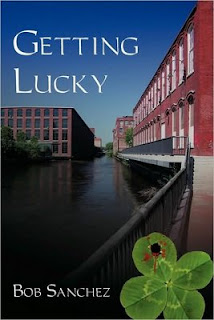 Getting Lucky by Bob Sanchez
(iUniverse / 0-595-53391-4 / 978-0-595-53391-6 / March 2009 / 196 pages / $14.95 / Amazon $13.45)
Reviewed by Lloyd Lofthouse for PODBRAM
Clay Webster loses his job after punching out a fellow police officer in front of his police chief, ninety-three schoolchildren and a reporter. That is where Getting Lucky begins. The setting centers on Lowell, Massachusetts.
It doesn’t take long to understand why Clay trashed his twenty-eight-year career in the police by punching out another officer. His youngest son is dead; his oldest son is a slum landlord, and his former wife has taken a girlfriend as her lover. After you get to know the police officer Clay knocked out, you understand why Clay did it. Office Mike Poirier is like the schoolyard bully with the big mouth that loves to torment others. Poirier deserved that punch.
Clay doesn’t know any other way to make a living after being a cop, so he becomes a private investigator. His son Jerry, the slum landlord, helps by setting up his dad in a shabby office in a run-down part of town.
I’ve read most of Robert B. Parker’s Spenser series, and Clay reminds me of a toned down Spencer, a man free of family ties, a loner, and someone that lives (sort of) by a code of personal honor. Clay’s best friend is Willis Chubb, an African-American police lieutenant. Chubb is not as tough as Spenser’s Hawk, but he is likeable enough that I wanted to see more of him in the story.
Getting Lucky is hard-boiled detective fiction. Sanchez’s writing style is lean and his main character is cynical, although not as cynical as Parker’s Spenser. However, Clay is cynical enough to draw out the occasional chuckle. I found Bob Sanchez’s style a hybrid of Robert Parker and Dashiell Hammett.
The story starts fast when the lovely Bonita Esquivez walks into Clay’s office and wants to hire him to find her missing husband, Lucky Esquivez, which explains the title. On the other hand, Bonita is not what she seems. Clay soon discovers that Lucky and Bonita may own an adult sex shop that is embroiled in controversy. Bonita claims she is only into making jewelry. Clay finds this difficult to believe. As the story progresses and we learn more about Lucky Esquivez, we begin to wonder why Bonita would want this guy back. Among the cast of characters, there’s a Senator Swinburne, and his name fits. Another character, Choop, a Cambodian teenager, sees a body in the local canal that may be Lucky Esquivez, but, for some reason, Choop is afraid to talk and with good reason. Soon, someone shoots Choop for what he knows, and he lands in the hospital in critical condition.
Getting Lucky has a touch of film noir to it emphasizing moral ambiguity and sexual motivation. When Bonita spends thousands decorating Clay’s office with new furniture and wall-to-wall carpet, Clay doesn’t turn her down. At this point, you may wonder why Bonita is looking for her husband if she is seducing the man she hired to find him. Is there an ulterior motive at work? To find out, you’ll have to read the novel. The fact that Clay may be in love with Chantal Ladoute, an old friend and ex-nun, doesn’t stop him from accepting the sexual favors Bonita offers, either, but it does stir up a pot of confusion and guilt. Like the old saying goes, “men are easy” but seldom forgiven.
I found Getting Lucky fun to read. I found a few slips in sentence structure and grammar but not enough to bother me. There’s a good chance that readers who enjoy Robert Parker mysteries will enjoy this one too.
See Also: Bob Sanchez' Website
Reviews of When Pigs Fly
 Waiting for Spring
by R. J. Keller
(CreateSpace / 1-440-46116-3 / 978-1-440-46116-3 / April 2008 / 480 pages / $14.95 / Kindle $3.19)
Reviewed by Celia Hayes for PODBRAM
Tess Dyer not only waits for spring, she is waiting for much else, in this leisurely novel which explores various aspects of contemporary family and parenthood, love and community, and the impact on them of addictions (of various sorts) and self-destructive behavior. Tess’s mood is as bleak, her emotions as frozen as winter in an isolated Maine community, to which she has fled following upon divorce, to try and build something of a new life for herself. There she finds friends – and lovers as well – most of whom have just as many problems as she does. She has not escaped life, in coming to a new place, renting her own apartment, taking up a new job, and developing a circle of new friends. She has just replaced all the old problems with new ones, but the novel also focuses on how she grew and came to deal with them, in slightly less self-punishing ways than previously.
The reasons behind Tess’ unhappiness, her divorce, and her dysfunctional childhood as well as much else about the demons that drive her are revealed at a deliberate pace, and with considerable skill. They are shown, or rather unfolded for the reader to discover, by Tess herself, a gritty, witty and seemingly tough survivor, who cleans homes and offices for a living and lives for art and love. Failing love, she has settled, over and over again, for sex and has enough self-knowledge to know there is something wrong, something unhealthy about that. Tess’s voice, and the characters of her friends and family that she sketches for the reader have considerable charm; otherwise this book might have seemed appropriate fodder for – if not Jerry Springer, then Oprah, at the very least. This book is told in first-person, which gives a very immediate feel to what Tess experiences and feels, but which also limits any exploration of how other characters react to her, save filtered through her own perceptions. Why do other characters in Tess’s world love and trust her? That question is scanted, but it is more a reflection on the way this story is told than any shortcoming of the author’s.
Editor’s Note: According to the authors’ website, proceeds from the sales of the book will be donated to Spruce Run, a local organization which deals with domestic abuse.
See Also: The Author's Website
The Spruce Run Website
Celia's BNN Review
R. J. Keller's Blog
R. J. Keller's Authors Den Page
 A Voyage Beyond Reason:
An Epic of Survival Based on the Original Journals of Benjamin Wade
by Tom Gauthier
(Outskirts Press / 1-432-71234-9 / 978-1-432-71234-1 / March 2009 / 408 pages / $18.95 / Amazon $17.05 / hardcover $30.95 / Amazon $27.85 / Kindle $6.40)
Reviewed by Juliet Waldron for PODBRAM
The first person who walked between the glaciers into a pristine valley, and then managed to come back and show the others how to get there, had a certain gene. Nowadays, this particular gene doesn’t get a workout very often, but here’s a story about a young man who possesses it, and what it made him do. A Voyage Beyond Reason is a novelization of the journals kept by Benjamin Wade during a voyage by kayak that took him from Baja to Colombia.
The title is apt. Ben Wade was in good physical condition and knew how to handle his craft, but other than that, there seems to have been little understanding of what his plan would entail. He cheerfully heads out equipped with a road map of Mexico, which obviously doesn’t contain information about the treacherous tidal currents of the Sea of Cortez, the place where his journey begins—and very nearly ends. He doesn’t know Spanish, he has little knowledge of the political situation in the various countries whose borders he’ll be crossing, and he isn’t an experienced seaman. You wonder if he’ll make it. There are storms, bad water, disease, hunger, fear, loneliness, and the occasional shark looking for a light snack. In short, it’s standard reality show fare: a more or less unprepared person pitted against Nature and his own limitations. In this case, however, there is the very real possibility that Ben Wade isn’t going to survive.
Survive he does, though, rescued (when necessary) by dumb luck, the kindness of strangers, Providence, and his own strength and perseverance. Ben has a lot to prove to himself, and a lot of growing up to do, but he seems, pretty clearly, to have done both during his journey, which does indeed end where he’d hoped, in Colombia.
A Voyage Beyond Reason is a fine adventure story. There were occasional grammatical/typographic errors, but the book is generally well put together and easy to read. There is what I’d call an “inspirational” subtext which some readers may like, but which may grate on others. My other caveat is that at 389 pages, it is far longer than it needs to be. This is something an editor could have remedied, but I put it down to the affection the author clearly has for his young subject. If you are a fan of the “true adventure” genre, ocean-going, exotic locale variety, or, if you are a Survivor junkie, you’ll probably enjoy this one.
See Also: The Hardcover Version (note the different reviews)
Tom Gauthier's Authors Den Page
Tom Gauthier's Website
 They Plotted Revenge Against America
by Abe F. March
(All Things That Matter Press / 0-982-27222-7 / 978-0-982-27222-0 / February 2009 / 254 pages / $16.99 / Kindle $8.79)
Reviewed by Malcolm R. Campbell for PODBRAM
Terrorism frightens people because it operates outside the traditional rules of war. It's hard to combat because the attacks are no longer limited to people wearing military uniforms at well-formed battle lines: they can happen anywhere, at any time, and they may well target people who don't have any direct knowledge of the peoples and issues involved. Part of the terror is the pervasive feeling that nobody’s safe.
This is the arena of Abe F. March's chilling novel They Plotted Revenge Against America. The novel is chilling, not because it's filled with “just more violence” in the Middle East, but because the story occurs on American soil as survivors of the American attack on Baghdad blend in to mainstream society to personally extract revenge against everyday citizens.
They Plotted Revenge Against America is a plausible, sobering, intricate and effectively plotted story about a group of well-trained, well-coordinated teams who slip into the U.S. with forged papers and then painstakingly work through a plan that will infect food and water supplies with a deadly virus.
These team members are not the gun-wielding, grenade-throwing stereotypical terrorists we see in most TV shows and movies. They are everyday people who have suffered personal loss and who want to fight back. Once their mission is complete, they plan, if possible, to go back to their normal lives. As the mission unfolds, they alternate between excitement and doubt while trying to avoid detection, and in the process, they discover while blending into community life, that Americans are not the monsters they expected.
March’s story tends to humanize both the terrorists and their victims, showing Americans as largely unconcerned and ill-informed about the agendas and issues involved in the long-time conflicts between Israel and its Arab neighbors. On the other hand, the terrorists see themselves not as criminals but as soldiers responding to what they view as acts of war taken against their communities.
Since the overall mission leader is a double agent working for Israel's Mossad, group members must not only avoid Homeland Security and other U.S. law enforcement agencies, but the highly effective Israeli intelligence agency as well. This subplot is a nice touch in a book that suggests we're more vulnerable than we suspect.
On a minor note, it’s a shame to see books from some of the newer publishers being printed in a sans serif body type. This is not only “not done,” but has been shown via many years of legibility studies to make blocks of type more difficult to read. That said, the book is not only a great story, but nourishing food for thought.
See Also: To Beirut and Back: An American in the Middle East
The March of Books Review
Abe F. March's Authors Den Page
 Devil’s Feathers by David Chacko
(Foremost Press / 0-981-84186-4 / 978-0-981-84186-1 / December 2008 / 268 pages / $14.97 / Amazon $13.47)
Reviewed by Jack Dixon for PODBRAM
Onur Levent has just begun his annual holiday on the Turkish Aegean coast. Holiday, though, means something different to Levent than it means to most people. Although he genuinely tries to leave his work behind, it follows him like a bloodhound. His holiday in the sunny resort town of Bodrum is interrupted by a phone call, and Levent is handed the task of solving the murder of a man with a murky background, dubious business acumen, and apparent connections deep inside the Turkish shadow government.
A nameless man, or rather one with perhaps too many names, has been burned alive in his car in the bustling coastal resort town. Levent must solve the puzzle of who torched the victim and why, and resist the urge to investigate the victim’s own colorful criminal background. Levent is as intrigued by the victim as he is by the hunt for his killer, but he forces himself to focus on the hunt. Still, he finds himself tugging at threads in spite of himself, even though he knows they will lead him to places he should not go.
Meanwhile, the investigation draws Levent away from the beaches, the dinner parties, and the nightlife that had been packed into his holiday plans. One suspects, however, upon getting to know Levent, that he secretly prefers the investigation to the beaches and the parties.
Well-paced dialog, clear and thorough descriptions, and believable dramatic scenes keep the story flowing nicely. The plot develops well, with a fine balance of action and mystery.
The intrigue and the intricacies of Detective Levent’s investigation held my attention in spite of distractions that periodically kept me away from this solidly written and finely edited book. I returned to the story easily after short periods away, as my interest held the details fresh in my mind. Fine books like this stay with you even when you’re forced to put them down for a time.
David Chacko writes with the ease of a polished storyteller. Ordinarily, I’m not a fan of frequent simile; I prefer that they be used sparingly. But Chacko turns similes like an expert potter turns fine art; I found myself looking forward to his creativity, and smiling when I wasn’t disappointed. Chacko’s style effectively conveys the aura and the mindset of the main character, a skilled veteran homicide investigator who holds his ideals loosely enough that he’s able to swim among personalities and situations that fall far short of them. This solid character’s ability to accept the underside of life without embracing it himself gives him a distinct edge in bringing his investigation to a successful, if harrowing close.
Devil's Feathers is a good mystery, with plenty of intrigue and well-drawn cultural flavor. I felt present in the Aegean resort town, immersed in the essence of Turkish culture and social mores, and absorbed by Levent’s dogged pursuit of elusive facts. A good writer takes the reader along for the ride; Chacko accomplished that admirably with this book. It’s the first of Chacko’s books I’ve had the pleasure to read, but it won’t be my last.
See Also: Al Past's Review of Echo Five
The Author's Website
 PODBRAM sails ahead with new submission guidelines! Did you think this was going to be a review of the last book by the funniest author in American history? Although I have read many of the earlier Don Martin books, I have never even seen a copy of this final release in 1986. The only Don Martin book I have managed to hold on to is a copy of Don Martin Steps Further Out (1975). I gave my copy of Don Martin Bounces Back (1963) to my niece many years ago, but I shall always remember fondly the misadventures of Fester Bestertester and Karbunkle. May Don, Fester, and Karbunkle rest in peace with great big grins on their faces!
This post noting all the changes at PODBRAM over the past six months or so is long overdue. None of this information is something I suddenly made up or even any sort of official policy change. The rules themselves have not changed, but the reviewers at PODBRAM have. All the changes can be simply traced back to a point at which a reviewer was added or additional book types or genres were added to the acceptance list. Let's sail ahead:
(1) No genre, publisher, or type of book is automatically disallowed, with the sole exception of books published by Lulu. I am continuing our policy of leaving that mass of submissions to the able hands of Shannon Yarbrough and his Lulu Book Review. I consider LLBR as a companion site to PODBRAM and I always encourage Lulu authors to apply there.
(2) Although no books are automatically disallowed, cheaters will be caught at the first gate. These generally include any POD book that has already sold well simply because it has a famous person or event listed in the title. Get-rich-quick and weight-loss schemes easily fall into this category, too. Historical fiction, political nonfiction, and a few others will be researched for the cheater gene, but most will pass the first gate. Generally, if your book title looks like one either The National Enquirer or The Wall Street Journal would love, you will be blocked at the gate.
(3) Unless a specific reviewer makes a decision to accept a specific book in an electronic format, all submissions must be in the form of actual print versions of published books.
(4) If your book is accepted for review at PODBRAM, except in very rare cases, you will get one. The rare cases are those few pieces of junk that somehow make it past the gatekeeper. When that happens, we shall be in touch with you via e-mail to discuss your options. Sometimes our PODBRAM reviews are harsher (read more explicit) than those we might post for the author at Amazon. These are the only cases in which we shall not automatically post a review at Amazon.
(5) All the PODBRAM reviewers post their reviews at Amazon. These vary from a direct copy and paste to a totally, freshly composed review, and anything in between. No posted Amazon review will be rated at less than three stars. We do this because (a) we know how much pie in the sky is slung about in the massive numbers of Amazon reviews and (b) we are playing this game to help authors, not hurt them.
(6) As the head curmudgeon, I shall never post another review at B&N because those clowns lost all my identifying remarks on the large number of individually composed reviews I had posted on their site for PODBRAM authors. The reviews are all still there, but you cannot tell which ones are mine, and all mentions of other PODBRAM-reviewed books are gone, too. Any of the other PODBRAM team members are free to post reviews at B&N if they want, but I'm taking my marketing talents and going to Amazon!
(7) Your review will be posted on additional sites according to the particular team reviewer. Yes, I know this is not exactly fair, but it is a better deal than you will get anywhere else. Most of our reviewers have at least one other site on which they post PODBRAM reviews, and remember, in many cases, these will be separately composed. You may get a reviewer who posts only at PODBRAM and Amazon, but at least that reviewer has specifically chosen to read your book, so he or she is very likely to enjoy it.
(8) Drum roll, please... the strip-search reviewer is generally retired, so your errors are not likely to be counted and the reviewer is not likely to check out every crevice with a magnifying glass! I could not go on like that, so I had to make a decision last year to mostly give up actually reading books for review and composing reviews. The editing alone for PODBRAM takes up a lot of my time, and I have two other blogs to feed!
(9) Don't get too excited about my retirement because the dunk tank is still full of ice-cold water! We still look at every facet of your book, from the cover design to the blurb on the back. The text better be edited and proofread or you will be receiving one of those intimate little talks about not posting your review.
(10) The way to acquire a review at PODBRAM has not changed. You must submit a simple, polite request to the editor at ice9 at nctv dot com or make a comment on any post at PODBRAM. You must include three things: the title of your book, your name (and pen name under which the book is published if one is used), and an e-mail address where you can be contacted.
(11) We do accept submissions from publicity firms; however, direct submissions will always be moved to the front of the line. We do this because many books we have accepted from publicity firms have never been received. We are not one of those fly-by-the-pajama-pants blogsites. If we accept your book for review, we have fully researched its quality and we expect not to have to waste our time herding an invisible book through our system. When I say the front of the line, I am referring to the acceptance stage of the process. All books are read and reviewed in the order in which they are received by the reviewer.
(12) Interviews require a considerable amount of my time. If you are accepted for an interview, it is because I think you truly have some particular knowledge that will be helpful to our readership, most of whom are probably POD authors themselves. You can request an interview, but only a few will be chosen.
(13) Whenever I receive a review request, the first thing I do is to locate the book at Amazon and elsewhere online. You will receive brownie points if the book has no reviews at Amazon or if little or no past Amazon sales are apparent. Aside from the cheater titles and subject matter, the first way to get a demerit is to have a load of glowing, five-star reviews and one or two that just happen to mention that the proofreader was absent that day. We have a red flag on the field of play! I know who the paid review sites are, too, and those will also earn you demerits.
(14) An informative, professionally appearing website will earn a brownie point, but an overly promoted one built by a paid professional will bring a dreaded, but unexpected, demerit.
(15) If I discover you to be one of those annoying nuisances who spam the author message boards and marketing sites with your repetitive, promotional hoopla, your book won't be accepted for review at PODBRAM.
(16) Tell me some good news! We at PODBRAM strive mightily to be the best of the POD bloggers. There are no ads on the site. There are only tons of links to other respectable reviewers, articles of interest to authors and their readers, and more telling of truth to power without snarkiness than you will find anywhere in the POD blog zone. We always include links to other websites and reviews from your PODBRAM review. You are free to use any review we write at PODBRAM, in whole or in part, in any way you wish in your book promotional efforts. We keep in touch with our authors as much as they individually require. The only exception is that all authors must communicate through the editor unless the individual reviewer accepts direct communication as a special case. No books are ever resold for profit at Amazon or anywhere else. All books reviewed stay on the reviewer's shelf as a worst-case scenario. Some are passed on to other reviewers, such as our fellow authors in IAG, some are donated to libraries, and some are given to prospective readers who like the particular genre. All operations at PODBRAM are, to quote the late Frank Zappa's second album title, Absolutely Free.
 Mozart’s Wife
by Juliet Waldron
(Hard Shell Word Factory / 0-759-94310-9 / 978-0-759-94310-0 / February 2005 / 354 pages / $15.95 / Kindle $6.00 April 2004)
Reviewed by Dr. Al Past for PODBRAM
Discovering this book was a slap-to-the-forehead moment for me. Of course! What a great subject! Most readers (myself included) know little more about Wolfgang and Constanze Mozart than they might have seen in the movie Amadeus, where what few insights were portrayed were notoriously inaccurate (being based on a work of fiction in the first place). Even if one loves Mozart's music, as so many do, and loves books about music and musicians, the personal lives and character of these two celebrities are largely unknown. In fact, the person who delves further into history will find that Constanze, in particular, has been treated unflatteringly and even harshly by the chroniclers, as so many famous women of history were. What a great opportunity to learn something about one of musical history's notable people!
Juliet Waldron reinterprets the life of Constanze Mozart in most convincing fashion in this splendidly researched and masterfully written account of her life from young teen to aged widow. Constanze is not a perfect woman: she has her faults. As a naive young girl, she is swept off her feet by the dashing and famous young prodigy, delights in his sensuality, and willingly marries him hardly knowing what kind of life she is in for. Her new husband, she comes to learn, is a spendthrift and bon vivant. Though devoted to her, he also works diligently to cultivate a whole city full of aristocrats, church officials, wealthy merchants with attractive daughters to be taught, networks of influential, often jealous artists and composers, and platoons of flashy, high-living show people. In addition, he must travel frequently, and, in whatever time remains, write immense quantities of music that will please the paying public. In addition, her in-laws appear from time to time to add to the misery.
An attractive, talented singer herself, Constanze has a hard life, though one not without its pleasures. She has status, she has clothes, and they generally live in sumptuous lodgings (which they can seldom afford). Custom does not allow her to manage their finances, however, and while both husband and wife delight in their children, she finds childbirth terribly difficult, debilitating, and on occasion, tragic. They quarrel from time to time, and when she finds proof that Mozart has strayed, she cannot resist straying herself.
The famous death scene in Amadeus is recast in Mozart's Wife, probably to fit the available evidence more closely. (As such, it is considerably more ghastly and affecting than in the movie.) The movie concluded at that point, but the real Constanze lived to be 80, discovering what love in a stable marriage is like, developing a keen sense of financial management, and helping pass on much of her first husband's music to the world. This period of her life is given full measure in the novel.
Ms. Waldron does a wonderful job of recreating an authentic feeling of life in 18th Century Austria. I am a music lover myself, and I enjoyed reading the names of the composers and other luminaries he ran across in his brief life: Salieri and Sussmeyer are fairly well known, but other lesser-known names were just as intriguing. Would you believe Casanova? In sum, Mozart's Wife is a thoroughly entertaining and even informative novel. The writing, editing and proofreading are very nearly perfect. There is an extensive bibliography of sources at the end.
I would call Mozart's Wife a fictional autobiography, though some might term it (or wish it) a romance. I wouldn't object, remembering that Ernest Hemingway once pointed out there is no such thing as a romance with a happy ending. Mozart’s Wife is highly recommended for fans of historical fiction and those interested in classical music.
See Also: Hand-Me-Down Bride (just released)
The High Spirits Review (scroll down the page)
Juliet Waldron's Website
 Women of Magdalene
by Rosemary Poole-Carter
(Kunati, Inc. / 1-601-64014-5 / 978-1-601-64014-7 / September 2007 / 288 pages / $24.95 hardcover / $18.21 Amazon)
Reviewed by Malcolm R. Campbell for PODBRAM
“It’s easy to get in, but once there it is impossible to get out,” New York World reporter Nellie Bly wrote in her “Ten Days in a Mad House” expose about the poor conditions and mistreatment of patients at Blackwell’s Island asylum in New York in 1887. Deplorable by today’s standards, the approach to mental health then wasn’t far removed from the days when professionals considered the insane to be those suffering God’s punishment or the Devil’s possession.
The fictional Magdalene Ladies Lunatic Asylum in Rosemary Poole-Carter’s darkly beautiful novel fits perfectly into a time period when the treatment of female mentally ill patients was likely to be neither moral nor effective. Confinement was often a matter of convenience for the families of women viewed as domestic failures who were best kept out of sight and out of mind.
When young Civil War surgeon Dr. Robert Mallory arrives at the Louisiana institution for employment as general practitioner after the war, he soon sees that God and the world have forgotten the women of Magdalene, and the only devils on the premises are the asylum’s owner Dr. Kingston, his former assistant Dr. Hardy, and their dictatorial matron.
When Robert questions Kingston about the inhumane treatment of the women housed in the former plantation mansion, Kingston discounts Robert’s competence to judge what is right and proper in the realm of mental illness. Later, Robert will ask why no women are ever cured and allowed to leave the facility. Cures? There are no cures, only what Kingston describes without noticeable guile as “sanctuary.”
In Poole-Carter’s haunting, yet gritty prose, Magdalene floats almost dreamlike within a misshapen world of malaise and mist that will ultimately claim all who remain there--and for a high price. Robert, like the women, arrives at the asylum having been harmed by the world and with a growing expectation that he will be injured further by the methods and practices within the shelter of Magdalene’s walls.
This novel casts multiple spells over its readers and its characters. Readers with a growing understanding that the abuses at the fictional Magdalene were drawn from the world of standard abuses of the times, won’t be able to forget what they see there. As for Robert Mallory, in spite of his resolve, he’s not sure he can complete his personal journey out of the past and cure what ails Magdalene before he becomes yet another shadow alongside the old plantation’s dark river.
See Also: The Powell's Review
The March of Books Review
The Author's Kunati Page
 The all-new POD-dy Train book review site has just left the station. The site was launched on April 7th with its official All Aboard! introductory post. The founder of POD-dy Train is a reviewer of both traditional and POD books, and an author of both types, too. Very little personal information has been released so far concerning the identity of this new blog's founder. He/she works in the publishing industry in New Yawk City and plans to review only self-published books for the new blog. Only print copies will be accepted for review. An e-mail address has been provided for contact. There are no mentions of queries, genres, or other special requests on the site, at least as yet, so I cannot offer any further details at this time. I assume that these issues will be forthcoming and I can then add the site's review request details to The De Facto POD Review Ring Chart. Like Cheryl Anne Gardner at POD People, The POD-dy Train also offers insights into the business world of the major POD companies.
I cannot take credit for discovering The POD-dy Train site on my own. Shannon Yarbrough of The Lulu Book Review sent me an e-mail yesterday, asking if I had seen POD-dy Train's review of PODBRAM. One of the unique concepts presented by this new blog is that other POD review sites will be reviewed, too. An author will be able to check out the reviews at POD-dy Train, the Ring Chart at PODBRAM, and the interviews at Breeni Books to comprehensively research all the potential online review possibilities for his book. I cannot thank you enough, POD-dy Train, for all the kind words you have said about PODBRAM in your review. I hope the PODBRAM team can continue to live up to your high expectations!
Now let's take a little train ride down into that old, dark, familiar tunnel containing some of the reasons why POD has such a disgraceful reputation in some circles. There are several ways in which an author can declare himself to be as unprofessional as the next guy. I read through this review, and I can only say that the reviewer seems be no tougher on the author than I have been on a few at PODBRAM. It is also quite obvious that this author has had success that I can only dream about. Some of the tackiest responses I have received from authors are ones that I essentially gave four stars instead of five, and that clearly seems to be the case here. I say essentially because we don't use star ratings at PODBRAM; however, I did give four stars to the same books at Amazon. Visit all the links and be sure to read all the comments. I think you will be aptly entertained, if nothing else!


