Friday, January 10, 2014

The Poison Ring


The Poison Ring by Freddie Remza
(Outskirts Press / 1-478-70541-8 / 978-1-478-70541-3 / May 2013 / 286 pages / $14.95 paperback / Amazon $13.46 / Kindle $6.99)

Let me begin by saying that, as with all my reviews, I have given a considerable amount of thought to my approach before proceeding. There will be technical criticisms in this review that will not appear in the Amazon review because PODBRAM is a place for authors to learn and Amazon is a place to sell books. Rest assured that I am not going to shred The Poison Ring here because it is a very competent effort deserving of the four stars I shall give it at Amazon. However, this book demonstrates several key lessons that I think are pertinent to the PODBRAM audience of fellow authors.

The Poison Ring is obviously a book for Young Adult readers, not for typical adults of all ages, but this fact is not noted on the book's Amazon page. If the prospective buyer checks out the Look Inside, the large print is a hint. I call the storyline Nancy Drew Goes to Nepal. The reading level is simple with lots of short declarative sentences composed in a typical third-person, past-tense style. There is an adequate level of show-don't-tell in the extensive dialog among the characters and the pace of the story is kept brisk to the end. The author is a retired teacher and there are discussion questions at the end. There is another bonus of ten B&W photos from Nepal in the back matter; however, the effect could have been improved by either moving the photos to their respective positions within the text or enlarging them to full-page size, or both. Ms. Remza is attempting to teach her student readers about Nepal and its culture, and she does an adequate job of this with the book. One detail the author missed is that the application of the past perfect tense would have been correct in several instances in the text. The story is told in a straightforward manner and the reader's interest will be held to the end.

This is Freddie Remza's fourth book with Outskirts Press, which brings up several points relevant to the PODBRAM readership. Although my own first four books were published with iUniverse, that is an approximate maximum number for an author to pay many hundreds of dollars to sell a small number of books. It's probably time for Freddie Remza to "graduate" up to CreateSpace. Whether or not the author paid for extra services at Outskirts, The Poison Ring is certainly one of the best proofread POD books I have encountered. Other than a minimum number of typos and the aforementioned tense issue, Freddie's fourth effort is a slick, professional product. If the author can reproduce this quality of work on her own at CS, she could be on her way to making more in royalties than she pays in fees.

The highest compliment I can pay to Ms. Remza is to state that in the genre of YA fiction, this book approaches the quality of that of ex-iUniverse author Dianne Salerni. She's not quite there yet. I think even YA readers could deal with a little more complexity in the plot and sentence structure. Her heart is in the touching zone and the technical quality of the product is commendable.

Sunday, December 15, 2013

Reunification


Reunification: A Monterey Mary Returns to Berlin  
by T.H.E. Hill
(CreateSpace / 1-490-49026-4 / 978-1-490-49026-7 / July 2013 / 226 pages / $12.95 / $11.66 Amazon)

Reviewed by Celia Hayes for PODBRAM

“Alas, poor Cold War, I knew it well. It was a war of infinite jest and most excellent fancy, fought more often in the shadows of the mind than to death, yet the lives of millions hung in the balance. It is a war without monuments, but not without casualties…”

Long-retired from the CIA, Mike Troyan returns to Berlin, where he once served as a military linguist – a Monterey Mary – at the Army Field Station in the 1970s. Now comfortably ensconced in academia, he intends to write a book about the Stasi, the East German secret police, and do a great deal of research in the Stasi archives, where the files they kept on almost anyone of interest have been pieced back together. But on his return he is almost immediately walloped by the realization that there was an informant among his comrades at the Army Field Station, an informant code-named MUSIK. He is also walloped in the face with a plate of currywurst by the mother of the head of the Stasi archives… a woman of his age who just happens to be his one-time Berlin girlfriend.

And with that, Mike begins unpacking and reviewing his suitcase of memories of divided Berlin, memories which are poignantly at odds with the present-day rebuilt, revived, and reunified Berlin. Everything he once knew so very well is either gone or changed almost beyond recognition; the Wall itself is gone, Checkpoint Charlie is a tourist attraction with the golden arches of a McDonalds’ in the background and manned by a pair of badly uniformed actors who pose for pictures with tourists, and one of the main recreational centers for American personnel in Berlin is now something called the “Dahlem Urban Village.”  “The sidewalk was full of people speaking German as they went about their business. All of them were unaware that they were walking down a street full of English-speaking ghosts who shimmered before me on their way to a PX that didn’t exist any more.” And when Mike’s daughter, Samantha comes to Berlin, about halfway through the book, the plot just thickens.

He remembers that particularly vivid past, as he tours present-day Berlin, by himself or with Samantha  – and accounts of the antics of his fellows at Army Field Station are interspersed now and again with how ominous the Stasi was to ordinary Berliners.” “The Stasi could make things not happen,” says one of the former East Berliners that he meets in his peregrinations about the city that he once knew so very well. “Your kids would not get into college. That apartment for which you were  three years on a waiting list was no longer available. The new car that you had paid for in full at the start of a six-year waiting list for delivery was suddenly delayed or postponed… and there was nothing you could do. There was no legal recourse because nothing could be done. There was nothing you could prove. There were no documents.”  For my money, that kind of impersonally deliberate bureaucratic malice is at least as chilling as the threat of overt violence, interrogation, and imprisonment with the threat of a capital sentence.

And now, to people the age of Mike’s daughter, what was once a very real menace is completely toothless, a rather shabby joke when not a focus for a weird kind of nostalgia. Only people the age of Mike and some of his old friends remember that it was all in grim earnest, as concrete as The Wall itself. One day, out of the clear blue sky, it all came down, dissolving into little chips of brick and concrete, valueless coins and clumsy relics like East German-made telephones (pre-bugged) and Trabant automobiles.

Reunification is quite readable, and nicely-plotted: part puzzle, part travelogue, part memoir and part history, with some quite nice turns of phrase, some of which I have quoted here. Mike on setting to work at the archives: “I’d worked in the salt mines of bureaucracy long enough to know the coin of the realm, and how to mint it.” For me, the passages which resounded were the melancholy episodes of re-visiting old haunts; just about every base which I served at in the 1970s and 1980s is either closed entirely, re-purposed by the host government or changed beyond all recognition. You cannot go home again, for strangers have taken it over.

Any criticism I have is directed at the basic formatting of the text itself; the margins are narrow, there is unnecessary spacing between lines and paragraphs, and the use of random fonts to indicate a shift from the present to the past, or to indicate a written document, is a little jarring. There are also inexplicable switches between the English and German conventions for quote marks around dialog. This does not reflect on the quality of writing or ability to tell an engaging story, but it does detract from aesthetic appreciation of the printed version’s pages. 

See Also: Voices Under Berlin, a 2009 PODBRAM Award Winner  

Sunday, December 01, 2013

The Bright Lady and the Astral Wind


by James Dunning
EXPLICATIO PARANORMALORVM - An Explication of the Paranormal
(Dolmen Tree Press / 1-463-56504-6 / 978-1-463-56504-6 / July 2011 / 270 pages / $14.95 / $14.20 Amazon / $2.99 Kindle)

Let me begin by saying that this book is one of the most professionally produced POD books I have seen. The proofreading errors were few and far between. I received with this book a full-color, two-sided brochure, a postcard, and a personally written letter. The author is a highly educated man from the Atlanta area who is well traveled in the U.S. and Europe, and this is his first book. The Bright Lady is a sort of autobiographical story of one element of the author's life. The action takes place over a seven-year period, beginning when he first sees the aura of a young woman who works for the same corporation, but in the building next door.

Is it live or is it Memorex? The most difficult part of writing an analysis of this book revolves around the space-cadet plotline conjured by a writer who is something of an expert in psychology, parapsychology, and linguistics. He is also a devoted fan and researcher of the legendary Tolkien Trilogy. He has a doctorate in pharmaceutical research and has held some sort of high-level position at a high-tech suburban firm, although not necessarily in the obvious field. The author is quite obtuse in whatever mentions or descriptions of his career are contained within the storyline. Most of the plot content takes place either at this business or on one of the author's several excursions to Europe, where he wallows in the languages of the area. The Bright Lady is described in a first-person account of Dr. Dunning's prophetic meeting with a mysterious young woman at the unnamed large corporation where they both work. He tells the story as if he himself is uncertain if he had experienced a series of deeply imaginative fever dreams, or if a truly paranormal experience has truly cloaked his mind.
I can understand what the author is trying to convey. The only question I have is how many other readers will enjoy it? As a fellow Psychology major, I read Freud's Delusion and Dream and I was indeed fascinated by somewhat similar, intense dream sequences. To this day, I dream profusely, all in 3D color with a full range of thoughts and emotions. However, my interest in foreign languages or fantasy book series is basically zero. There certainly may be many readers who will ascertain many details from these elements and be deeply moved by the author's applications of these concepts. My favorite parts are the author's deep discussions with his old friend concerning his travails and unexpected delights with The Bright Lady. The final interpretation will have to rest with each individual reader.
The author drew or painted the cover images and there is a bibliography of resources describing the author's detailed influences. Dr. Dunning mentions that he dislikes the distraction of footnotes, and with that I could not agree more. The story flows nicely, whether you take it as gospel nonfiction, the memoir of an eccentric, or a delicately told tale of silent desire and delusion.

Tuesday, November 12, 2013

Submissions Are Open!


Heads up! For a brief period at least, submissions for book reviews are now open at PODBRAM. Why are they open now, after all this time? Because I am bored and I need something new to read. All the previous PODBRAM rules and details apply. If you want to know more, refer to the articles listed in the left column under "Submitting a Book for Review". There are no PODBRAM team members involved in this opening for submissions. I assume they are all still busy with their own projects. It's just little old me, just like in the early days.

Here is a refresher on how to get your book selected for review. (1) Only print books are accepted. (2) All publishers are accepted. (3) No children's books, youth books, fantasy, science fiction, or get rich quick titles will be accepted. (4) Genre romance or Christian will not likely be accepted. (5) Mystery, biography, thriller, horror, and various nonfiction genres will definitely be considered. (6) If you are an unknown, self-published author with few or no reviews at Amazon, your work will be more likely to be accepted for a review simply because you need it. (7) I count errors, and although I accept a higher percentage of these from self-published writers, I am never oblivious to them, no matter how strong the book's content.

If your book is accepted for review, here is what you can expect. (1) The review will be posted at PODBRAM and Amazon within a decent timeframe. (2) These two reviews may or may not be identical, depending upon my opinion of the book and other details. I generally tend to mention the errors and technical flaws more in the PODBRAM review since this site is mainly for self-published authors to learn from each other. (3) I shall read every word of the book, as well as take note of the details of its presentation. (4) My reviews are always direct, honest, and well thought out prior to publication. You are getting the opinion of a writer who has published seven substantial, detailed, nonfiction books since POD was in its infancy, so I know exactly what it takes to properly write and self-publish a book. (5) I view paid book reviewers with disdain. The only cost at PODBRAM is the mailing of a printed copy. Some authors send books directly from Amazon as an easy alternative. (6) Accepted submissions are read and reviewed in the order in which they arrive in my mailbox.

Requests should be sent to ice9 at nctv dot com. A detailed description of the book in the e-mail is unnecessary. A simple link to your book at Amazon is sufficient. Your message will be answered promptly. If accepted, the address to send the book will be included in the reply. Thank you for your support of PODBRAM.

Thursday, June 20, 2013

Without Apology


by Jacqueline S. Homan
(Elf Books / 0-981-56795-9 / 978-0-981-56795-2 / March 2013 / 356 pages / $19.95 paperback / Amazon $18.84 / Kindle $5.99)

This will be a difficult review for me to write, since I am a fan and supporter of Jacqueline Homan's work. I have read and reviewed Ms. Homan's previous four books and this one does not veer far from the course of the others. However, I have a very difficult time swallowing the author's premise that all men are bad and all women are good. Of course I cheer on her rants when she goes after the severe disparity in economic justice that has become the relentless status quo in modern America, but the author's premise for this book is overly simplified, to say the least. Ms. Homan states repeatedly throughout this book that men are the problem, as they have been for 6000 years, and women have consistently lacked autonomy and bodily integrity for this reason alone. It would have been much more prudent to include such a statement a couple of times in the book, rather than repeatedly, over and over in much the same language.

Jacqueline's life story and accomplishments deserve the whole hour of an Oprah episode. The mostly female audience would love it! There is great honor in the extreme level of self-improvement that Jacqueline has accomplished. Whenever she goes into research mode in her writing, this book, and all the previous ones, too, show off a level of creativity that is quite commendable. Without Apology is full of such detailed research, and that part of the story is very well told, but, please, enough with the repetitive rants. We get it, you have been abused by men most of your life, but that does not mean that all women have or that all men are the world's villains.

There are a few technical details that scream self-publishing and they should be excised from Ms. Homan's future work. Most of these involve simple proofreading and a little extra time to prepare the book for publication. The back cover blurb is only one short paragraph, leaving mostly white space, and one key word is misspelled. The inside margin is a little tight. The paragraphs are both indented and line spaced. The front matter could be more complete, adding a professional look.

This book is as exciting to read as Jacqueline's previous work. You never know whether she will be in rant mode or research mode from one paragraph to the next, and the surprises are fun to a certain extent. She goes from street language to academia and back with her usual aplomb. I think it is time for Jacqueline to take the next step in the maturation process as an author. The real causes of our nation's severe income inequality issues are somewhat complex. Our history has gone from The Great Depression to the New Deal to the explosive Sixties to the oppressive decades since. The Southern Strategy has been a much more accurate villain for Ms. Homan's rants than have all men. I suggest she consider this fact. Women are the leading church goers; in most cases, they drag their male family members along. In other words, the Southern Strategy is the real cause of Jacqueline's and everybody's misery, and women have been involved in that madness as much as men. This author's writing style and subject matter are commendable, but I honestly thought she might have gotten past all the relentless ranting with her first book. Do not misunderstand. I think Without Apology is quite a good read and a relevant story for our modern culture. I also feel it is time for Jacqueline to look past her ancient rage and mature a little as an author. The core premise of Without Apology is just too simplistic. Unless you are already a raving feminist of the female persuasion, this book will not offer much appeal. I want to see the accomplished author Jacqueline Homan on Oprah!

Tuesday, November 27, 2012

Course Corrections


Course Corrections: 
One Man's Unlikely Journey 
by Larry J. Nevels
(iUniverse / 1-462-01636-7 / 978-1462016365 / July 2011 / 316 pages / $18.95 paperback / $28.95 hardcover / $7.69 Kindle / $8.49 Nook)

Reviewed by Dr. Al Past for PODBRAM

Course Corrections is the late-in-life memoir of Larry J. Nevels, 1945-2011. Commander Nevels died last year, a retired, carrier-qualified Naval aviator, among other achievements, after a most humble and unlikely beginning. On one level the book he put together is a classic American rags to riches story ("riches" being defined in terms of personal reward rather than mere pelf). That is, it is a testament to gumption, persistence, several doses of luck, and the out-of-the-blue generosity of people who must have sensed his innate drive and decency. On another level, it is simply a terrific read. CDR Nevels had a great memory and a practiced story-teller's eye for detail and timing.

He was born into a broken, dysfunctional family who scorned those who went to college as effete snobs. His "home life" was hardly that, since he lived in a number of foster homes and occasionally struck out on his own when he was barely a teenager. Buoyed inexplicably by great faith, endurance, and optimism, he survived into high school, where he was given timely nurture (and a home) by a legendary teacher and life lessons from a tough, caring football coach. Their support led him to a football scholarship at a good college, and that, with several more strokes of luck, led him to Navy flight school and a long, successful career as a Naval aviator.

Whether one reads for inspiration or entertainment, Course Corrections is a fine book. I shook my head many times, laughed out loud a few times, and admittedly got misty eyed more than once. Few people know more great stories than old Navy veterans, and few Navy veterans know more great stories than old Naval aviators. I'll relate an example from the second category if I may. It's a sea story of the PG-13 variety, and concerns one of the crewmen on his plane rather than CDR Nevels himself.

Naval aviators must endure long deployments away from home, many of which are extended unexpectedly and bring considerable strain to family life. One of CDR Nevels' crewmen once telephoned his wife that he was finally returning home. Come meet the plane, he told her, "with a mattress strapped to your back." Her response: "Don't you worry about me. Just make sure you're the first one off the plane!"

For my part, as a long-time indie author, I have to say that the copy editing of the book leaves something to be desired. The book was rushed into print: only four months after it was published, CDR Nevels succumbed to a protracted battle with cancer. Still, potential readers should know that these problems are small and do not in any way detract from the impact of the prose. The book is great entertainment, documents the life of a remarkable person, and stands as an inspiration to those who read it.

I would never have discovered this book if my wife had not been a high school classmate of CDR Nevels. He visited our town, the town where he graduated from high school, in later years, and I came to know him as a calm, well-adjusted person, with nothing unusual about him except perhaps his life in the Navy. (I had been a non-career surface officer in the Navy myself, so we shared a certain bond.) My wife and I once stayed at the bed and breakfast he and his wife maintained in Fredericksburg, Texas, where we admired his renovation of a period pioneer Texas home and enjoyed his hospitality. Neither she nor I had any inkling of his extraordinary path to the present until we learned of his book.

Course Corrections is a sterling example of the value of independent publishing. I can't imagine any of the literary-industrial complex big four (or is it big three?) taking a risk with a book like this. That's their misfortune. This is a fine, fine book and it is worthy of a much wider readership. CDR Nevels said, of his career in aviation, that the number of his takeoffs equaled the number of his landings, and that is one of the best things you can say about a career as a pilot. My wife and I can only wish this extraordinary man a happy landing on his final journey.

Tuesday, April 03, 2012

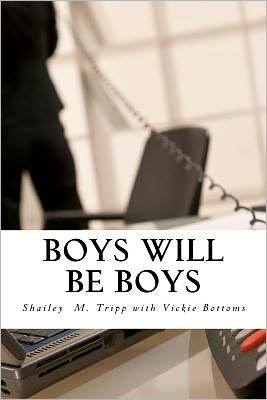
Boys Will Be Boys


Boys Will Be Boys:
Media, Morality, and the Coverup of the Todd Palin Shailey Tripp Sex Scandal

by Shailey M. Tripp (with Vickie Bottoms)

(CreateSpace / 1-470-09102-X / 978-1-470-09102-6 / February 2012 / 280 pages / $21.50 / Amazon & B&N $19.35)

 Boys Will Be Boys is the true story about a young woman who met Todd Palin, probably not inadvertently, in late 2006, just as his wife was being elected Governor of Alaska. Shailey Tripp was working as a substitute teacher at a school in Wasilla when she one day had the honor of being the enforcer of ladylike behavior in the school cafeteria. One of Todd Palin's daughters, Shailey does not specify which daughter, was continually breaking in the cafeteria line and acting most unladylike. Due to the ages at the time, this had to have been either Bristol or Willow Palin. My bet would be preteen Willow. Shailey Tripp did her duty and sent the child home with a note for her parents and Todd did his parental duty and showed up at the school to discuss the issue. Thus began a relationship that would travel through occasional sexual dalliances until it culminated (allegedly) in an interstate prostitution ring. Somebody famous would become the pimp and a certain substitute teacher, who also worked at a massage parlor, would become the prostitute. In case you are wondering how the teacher could also work at a massage parlor, the story is that this particular massage parlor was not one of those massage parlors until Todd Palin sweet-talked his way into the massage therapist's ear.

That's all the plotline you are going to get from me. Some of you may have read pieces of the story in The National Enquirer a couple of years ago. If you want to read the whole story, right from the massage therapist's hands, then this is the book for you. Here is one more little tidbit for you: Shailey Tripp also gave a massage (without a happy ending) to an unpregnant Governor Palin in March 2008. There lies the rub. (I couldn't resist!)

Here are my usual book review criticisms, of which I have become legendary at PODBRAM. There is as yet no Kindle or other e-book version of this book. Unlike all the other reviews I have written here at PODBRAM, this one derives from a PDF of the book. I did that on purpose because, if you have followed my writings on my main author blog, you know that I have been intimately involved with this subject matter for nearly four years. I knew beforehand that many police reports and other documents had been scanned into the book and that the ability to increase the font size would be beneficial to my old eyes. (Cue Sgt. Pepper: "When I'm 64".) When you read the print version, you might have to squint a bit to read the details of many official documents included in the Appendix that substantiate many of Ms. Tripp's seemingly outlandish claims. You may be a little annoyed by the full-size, rather than half-size, paragraph indents throughout the book, as well as much of the content that seems to be a little too often repeated. One segment spanning several pages appears to be literally repeated. In her favor, the number of common proofreading mistakes in a self-published book have been kept within reason. I do think it a bit strange that the subtitle is not included on the cover, though.

Boys Will Be Boys is a very important contribution to American political culture. Anyone who wishes to know the whole truth of our recent national politics should read it. Of course they should read my own Paradigm Shift, too, but that's another story... or is it?

See Also: A very different perspective at NIAFS.

Monday, February 20, 2012

This Mobius Strip of Ifs


This Möbius Strip of Ifs
by Mathias B. Freese

(Wheatmark / 1604947233 / 978-1604947236 / February 2012 / 186 pages / $10.95 / Kindle $9.99)

Reviewed by Malcolm R. Campbell for PODBRAM
Mathematician and physicist Clifford A. Pickover has called the Möbius strip “a metaphor for change, strangeness, looping and rejuvenation.” Like the surface of a Möbius strip, the thirty-six essays folded into This Möbius Strip of Ifs ultimately have no front or back or beginning or end because Mathias B. Freese views his life, his work and his world as a continuous and open-ended process of awareness without the conventional limitations of meaning or dogma.
In “Untidy Lives, I Say to Myself,” Freese writes “That awareness of the moment or the one after that is about all this old man wants at this point in his life. I am working—by not working—on being ‘spot on’—love that phrase. A pastrami sandwich and a good pickle and Dr. Brown’s Cel-Ray soda is an epiphany for me if I am aware of it.”
Like the other eighteen essays in Part I, Knowledge is Death growing out of Freese’s experiences as a writer, teacher and psychotherapist, “Untidy Lives” explores the raw awareness and infinite potentialities open to individuals who risk true autonomy. The “risk,” as Jane Holt Freese suggests in her introduction, is that “to know who we are requires that we ‘die’ to many ideas we have about ourselves. Paradoxically, this ‘death’ quickens awareness, makes us more alive and sensitive.”
In “Teachers Have No Chance to Give Their Best” and “The Unheard Scream,” Freese—who taught for twenty-two years before becoming a therapist—decries the fact that school systems don’t provide environments conducive to learning. We have regimentation and conformity with energy being “siphoned off into empty rituals” in a system that conditions students and teachers to accept rote truths rather than to explore oneself without boundaries.
In “Jefferson,” Freese describes the profound and lasting impact of reading the words inscribed in the rotunda of the Jefferson Memorial during a college-years Washington, D. C. visit: "I have sworn upon the altar of God eternal hostility against every form of tyranny over the mind of man."
“I felt I was Moses before the burning bush, on hallowed ground,” writes Freese, “as those words were inscribed in flame into my mind—alas, not my heart. I etched them info myself. I have never forgotten them.”
Readers of these essays may infer that Jefferson’s words opposing a Constitutionally recognized state religion became for Freese, if not a mantra, a Möbius-strip axiom that threaded its way in loops within loops through every aspect of his life and work. Jefferson’s influence is certainly apparent when, in “Introductory Remarks on Retirement from a Therapist” and “Therapist as Artist: A Short Talk to the Stony Brook Psychological Society.” In Freese’s view (and no doubt in Jefferson’s) therapists help clients find self-truths rather than conditioning them to adapt to society’s truths because “society is essentially corrupt and corrupting.” The therapist, then, sees life as an artist sees life.
In addition to Jefferson, the truths of Jiddu Krishnamurti, Nikos Kazantzakis and Albert Camus weave the essays in This Möbius Strip together into a unified whole. Freese is the Freese he is not only because of his parents’ lack of parenting and the personal suffering following the loss of a daughter and a wife, but because of his formless evaluation and appreciation of the work of these men. Their spirits remain close at hand in the Freese’s essays about education, therapy, writing and book reviewing and the Holocaust in Part I, Knowledge is Death as well as in the film essays in Part II, Metaphorical Noodles and the family recollections in Part III, The Seawall.
Freese’s Metaphorical Noodles celebrate the work of passionate actors and filmmakers who fought for artistic freedom in a movie business that pushed conformity with the same fervor as school systems and preachers: Buster Keaton, Peter Lorre, Federico Fellini, Orson Welles, and Clint Eastwood. Freese’s The Seawall celebrates family, from his daughter Caryn, who committed suicide in 1998, after a long battle with Chronic Fatigue and Immune Dysfunction Syndrome (CFIDS) to his wife Rochelle, who died in an automobile accident in 1999, to his “wayfarer” Grandma Fanny and World War II veteran Uncle Seymour.
In the final essay, “Reflections on Rummaging,” Freese summarizes everything else in this astute and profoundly engaging collection of essays while sitting in his garage with several boxes containing the collected records and mementos of a lifetime when he thinks that the riches and adventures of the world can’t give him what he needs most: “To enter into a moment of awareness—I’m not greedy—in which I can feel and experience congruity with myself.”
Somewhat cautionary, occasionally prescriptive, and always uncompromising and unapologetic, This Möbius Strip of Ifs offers readers the observations of one man’s lifetime of bucking the system and seeking a harmonious environment for the ever-awakening psyche within.
Malcolm R. Campbell is the author of four novels, including the contemporary fantasy “Sarabande.”

See Also: The i Tetralogy

Wednesday, January 25, 2012

Distant Cousin: Recirculation


Distant Cousin: Recirculation
by Al Past

(CreateSpace / 1-460-94624-3 / 978-1-460-94624-4 / February 2011 / 324 pages / $13.95 / Kindle $4.99)

Let me begin by saying that this is one of the most accurately proofread books I have reviewed for PODBRAM. I found exactly one extraneous word and the use of ellipses in dialog is a little overdone, but the buck stops right there. However, there are a few glitches in the formatting of the print version that I read. I cannot speak for the Kindle version, of course, and I am aware that the majority of the readers of Dr. Past's legendary Distant Cousin books read them on a Kindle, so maybe these formatting issues are somewhat irrelevant. The problems boil down to two issues. First, the front matter is all but nonexistent, and this makes the printed book appear amateurish at first glance as soon as the first page is turned. Al could spend a little time on this and the book would have a much more professional look. In contrast, the back-matter is outstanding! The final page, describing Ana Darcy's personal website, should be added to the first four books in the series. (Of course I realize this is out of the question for the print versions, but this page could easily be added to the Kindle ones.) The second formatting issue is more complicated (and more annoying). Recirculation should have been only about 200 pages, possibly lowering the price even further. The font is too large, the text is not justified, and each page begins with a new paragraph. I understand technically how this happened, but I am sure most readers would be quite confused by it. The result is that many pages containing a few large paragraphs show large expanses of white space at the bottom. Pages with many short paragraphs of dialog are less affected. Readers of a future DC6 would probably appreciate it if Al would work on some of this technical mumbo-jumbo.

I can see it coming already. Ana's half-alien, genius son will be exposed by nosy media personnel. Somebody in the editing room will see that boring footage that the gossip show left on the cutting room floor and all hell will break loose! The best thing about Recirculation is the storyline and the Spielbergian character development, as is the case with the four previous Distant Cousin books. This part of the friendly space alien saga features the teenaged twins, Julio and Clio. We learn much more detail about Julio's engineering acumen and Clio discovers healing powers she did not realize she had. There is a section of the book that takes me back to the Don Juan books of the wonderful Sixties when Clio goes to Mexico to meet with a traditional healer. Ana's flying pod takes the crew on yet another adventure, leaving the reader salivating for DC6. What more could the readers ask?

There is a lot I could say about the plot, but of course I won't. If you have gotten this far in the series, you already know what to expect. The best thing about the Distant Cousin books is that the reader can so easily visualize the movie in his or her head with very little provocation. The storyline is new, yet familiar. The essence of Spielberg's Close Encounters or E.T. remains pervasive throughout. The characters and dialog tell the story. The whole thing is show, don't tell in a manner that any reader can appreciate. The storyline flows, the characters develop comfortably, and you feel as if you are so glad that you know these people! I was particularly pleased with the pacing of this fifth in the series, the way it begins slowly and gradually accelerates to the end. Personally this is my third favorite, behind Reincarnation ( DC3) and Distant Cousin, and clearly ahead of DC2 (more action and less character development) and DC4 (emphasis on new ancillary characters rather than Ana Darcy). My final grades are: formatting C-, editing and proofreading A+, storyline A.

"Hey, Joe, come over here a minute. Have you seen this? I know most people would think that kid is just shining on his captive audience for a goof, but I've heard of that fancy thing he's talking about. It's been discussed in certain scientific papers. Some experts think it will be a real breakthrough. I'm going to make a few calls...."

See also: Distant Cousin
Distant Cousin: Repatriation
Distant Cousin: Reincarnation
Distant Cousin: Regeneration
Interview with Dr. Al Past

Friday, July 22, 2011

El Secreto Submergido


El Secreto Sumergido
by Cristian Perfumo

(Amazon Digital Services / Kindle Edition B004VS7LMC / (no date of publication) / 341 KB / $2.99)

Reviewed by Dr. Al Past for PODBRAM

Although my last class in literature in Spanish was 40 years ago, I undertook to read this El Secreto Sumergido because the subject matter interested me, and I thought it would be a good review for me. It was worth it. I like a good adventure story and I like a mystery, and I particularly like stories connected with the sea. El Secreto Sumergido was both, with the dividend that it offered a glimpse into a part of the world that I was barely aware of: Patagonian Argentina. As a bonus, the unpleasantness of the "Falklands War," as the English speaking world knows it, that is, the dispute between England and Argentina over the possession of Las Islas Malvinas, in the south Atlantic east of Argentina, also figures in, mainly in the epilog.

Basically, a high school student in the (real) town of Deseado learns of a (real) British shipwreck 200 years earlier on the rocks of the mouth of the river where his town is located. As a new but enthusiastic SCUBA diver, he decides to investigate, and perhaps locate the wreck. When the retired seaman who provides him with early documentation of the wreck is mysteriously murdered, that sets off a train of events that the young man and his friends pursue to their violent end. It is a rollicking tale.

Keeping in mind that my skills in Spanish are a bit rusty, I will say that I found the book well and cleanly written. As a former non-SCUBA diving officer in the American surface navy, I'll add that the details of diving in the cold tidal waters of the mouth of a river, and of the hazards of undersea salvage, struck me as accurate.

The English-dominant reader who is intrigued by the book and who has some skill in Spanish and a decent desk dictionary should enjoy El Secreto Sumergido as much as I did.


Dr. Al Past is the author of the five Distant Cousin novels, a popular adventure/romance/sci-fi series, the photographic collaborator for Barry Yelton's On Wings of Gentle Power, the author of a book of treble clef duets from Charles Colin, a reviewer for PODBRAM, and a member of the Independent Authors Guild. He lives on a ranch in south Texas.

Friday, July 15, 2011

Uncle Denny


Uncle Denny
by Don Meyer


(Two Peas Publishing / 0-984-07739-1 / 978-0-984-07739-7 / June 2011 / 318 pages / $14.95 paperback / $11.66 Amazon / $7.99 Kindle / $14.36 B&N / $7.99 Nook)

Uncle Denny is Don Meyer's completion of the Sheriff Tom Monason Trilogy, a series of crime thrillers set in an unnamed ski town high in the mountains of California. The sheriff is an experienced cop from the big city, now nearing semi-retirement age and running a tiny, informal police department in what should be a sleepy town, but rarely is, sort of like Paradise MA or Cabot Cove ME. As you may have already guessed, most of the charm of Don's trilogy comes from his quiet town of amiable characters. The main distinction from those similar settings of novels and television is that blizzards and heavy snow often play key parts in the crimes solved by Sheriff Monason, and the plot of Uncle Denny is no exception.

Key storyline elements from Winter Ghost and McKenzie Affair have been woven into this third book, but the story pretty much stands alone for any reader who has not read the earlier books. You can read my reviews of these earlier two by clicking the links, and I highly encourage you to do so, since I am not repeating much of that material here.

I personally enjoyed McKenzie Affair the most of the three, and Uncle Denny the least. This is the direct result of so much of this newest storyline surrounding two groups of feuding mobsters in Chicago. Mr. Meyer explains this concept in closing remarks at the end of the book. The author describes how he spent most of his life in Chicago and that he wanted at least one part of the trilogy to evolve from this experience. That is fine if you like mobsters, but these sorts of characters have little appeal to my tastes. Maybe yours are different. I have memorized all the Andy Griffith reruns, but I have never watched The Sopranos. Enough said?

The title derives from a mispronunciation of a lead character's name, that of a Russian mobster. An FBI agent phones Sheriff Monason to explain that several criminals from Chicago are headed to Monason’s town. Because of a severe blizzard in the area, FBI personnel cannot reach the scene quickly enough, so the sheriff and his few deputies need to head off the mobsters at the pass, as they used to say in old westerns. The reader is introduced to the malicious modus operandi of Uncle Denny early in the story, and then the plot begins to unroll.

Don Meyer writes in a very direct, concise manner, telling his story mostly through incisive dialogue with little extraneous descriptive detail. Uncle Denny is a somewhat satisfying read, but proper editing and punctuation are sorely lacking. There are way too many repeated phrases. A few examples are that cell phones are always pinched closed and Sheriff Monason’s desk chair always squeaks; however, I was most annoyed that Uncle Denny always drives a big black SUV. It is never a sport utility vehicle, a Cadillac, an Escalade, a truck, a snow-covered vehicle, or even a black SUV or a big SUV. An editor should mention these to you. Do you get my snowdrift, Don? I really like your settings, plotlines, and most of all, your folksy characters, and I think most readers will, too.

See Also: Winter Ghost at Amazon
McKenzie Affair at Amazon
The Protected Will Never Know
Don Meyer's website

Saturday, February 12, 2011

Living With Evolution or Dying Without It


Living With Evolution or Dying Without It: A Guide to Understanding Humanity’s Past, Present, and Future
by K. D. Koratsky

(Sunscape Books / 0-982-65460-X / 978-0-982-65460-6 / June 2010 / 618 pages / $49.95 hardcover / $37.30 Amazon / $14.99 Kindle)

Reviewed by Lloyd Lofthouse for PODBRAM

Koratsky's book is a heavily researched, scholarly work that gathers what science has discovered since Darwin's discoveries and fills in the gaps explaining why evolution has something to teach us if humanity is to survive. The other choice is humanity going the way of the dinosaurs into extinction.

I started reading in early 2010 and took months to finish the 580 pages. The Flesch-Kincaid Readability level would probably show this book to be at a university graduate level leaving at last 90% of the population lost as to the importance of its message. For months, it bothered me that so many in the United States do not have the literacy skills to understand an important work such as this. (The average reader in the U.S. reads at fifth grade level and millions are illiterate). This is certainly not a good foundation to learn how precarious life is if you do not understand how brutal the earth's environment and evolution has been for billions of years. As I finished reading Living With Evolution or Dying Without It, I realized that it would only take a few key people in positions of power to understand the warnings offered by Koratsky and bring about the needed changes in one or more countries so humanity would survive somewhere on the planet when the next great challenge to life arises.

On Page One, Koratsky starts 13.7 billion years ago with the big bang then in a few pages, ten billion years later, he introduces the reader to how certain bacteria discovered a new way to access the energy required to sustain an existence. By the time we reach humanity's first religion on Page 157, we have discovered what caused so many species to die out and gained a better understanding of what survival of the fittest means. To survive means adapting to environmental challenges no matter if they are delivered by the impact of a monster asteroid to the earth's surface, global warming (no matter what the reason) or by competition with other cultures or animals competing for the earth's resources. In fact, competition is vital to the survival of a species for it is only through competition that a species will adapt to survive.

The book is divided into two parts. The first 349 pages deals with where we have been and what we have learned, and the two hundred and eleven pages in Part Two deals with current ideas and policies from an evolutionary perspective.

I suspect that most devout Christians and Muslims would dismiss the warnings in this book out-of-hand since these people have invested their beliefs and the survival of humanity in books written millennia ago when humanity knew little to nothing about the laws of evolution and how important competition is to survival. Koratsky is optimistic that the United States will eventually turn away from the political agenda of "Cultural Relativism" that has guided America since the 1960s toward total failure as a culture. The popular term for "Cultural Relativism" in the US would be "Political Correctness", which has spawned movements such as race-based quotas and entitlement programs that reward failure and punish success. Even America's self-esteem movement is an example of "Cultural Relativism", which encourages children to have fun and praises poor performance until it is impossible to recognize real success. The current debate started by Amy Chua's essay in The Wall Street Journal is another example of "Cultural Relativism" at work.After reading Living with Evolution or Dying Without It, it is clear that Amy Chua's Tiger Mother Methods of parenting are correct while the soft approach practiced by the average U.S. parent is wrong and will lead to more failure than success.

Koratsky shows us that the key to survival for America is to severely curtail and eventually end most U.S. entitlement programs. While "Cultural Relativism" is ending, competition that rewards merit at all levels of the culture (private and government) must be reinstituted. He points out near the end of the book that this has been happening in China and is the reason for that country's amazing growth and success the last thirty years. In the 1980s, merit was reinstituted at the bottom and most who prosper in China today earned the right to be rewarded for success by being more competitive and adapting. Even China's state-owned industries were required to become profitable or perish.

The earth's environment does not care about equality or the relativists' belief that everyone has a right to happiness even if society must rob from the rich and give to the poor. This book covers the evolution of the universe, the planet, all life on the planet including the reasons why most life that lived on the earth for hundreds of millions of years before humanity is now gone; the beginnings of the human species; religion in all of its costumes; the growth of civilizations and the competitions that led to the destruction and collapse of so many such as the Roman Empire and the Han Dynasty two millennia ago. The environment and evolution says that all life on the planet is not equal and no one is born with a guaranteed right to success, happiness and fun. To survive means earning the right through competition and adaption. If you don't believe Koratsky's warning, go talk to the dinosaurs and ask them why they are gone.


See also: K. D. Koratsky's Website

Saturday, January 08, 2011

Submissions Are Closed


Review submissions are closed at PODBRAM until further notice. Thank you for your support.

Sunday, October 17, 2010

Dance Your Way to Psychic Sex


Dance Your Way to Psychic Sex
by Alice Turing & Francis Blake, Illustrator

(Chutzpah Publishing / 0-956-65660-9 / 978-0-956-65660-5 / September 2010 / 420 pages / Amazon UK 20 Pounds Sterling)

Reviewed by Dianne Salerni for PODBRAM

We easily believe what we ardently desire to be true.

This is the tagline for Alice Turing’s novel, Dance Your Way to Psychic Sex, which tells the story of a book (called That Book) and a New Age movement called Psychic Dancing that takes Great Britain by storm. Leo, a mentalist by profession, knows it’s a scam. It has to be a scam, and he’s both envious and contemptuous of whoever thought it up first. Henrietta also thinks it’s a scam, because Henrietta knows all about brainwashing – and she really doesn’t want to experience that again. Yet, both Leo and Henrietta find themselves sucked into the Psychic Dancing uproar because Belle and Denzel believe it whole-heartedly. And Henrietta loves Belle. But Belle loves Leo. And Leo doesn’t want to believe he’s fallen in love with quirky Denzel, but Denzel won’t have sex with him until Leo admits he’s gay.

I was expecting a humorous romp from this book, and perhaps an exploration of belief, desire, and illusion, explored through a bizarre psychic hoax that might turn out to be real. From the description on the cover, I thought the romantic quadrangle would involve the farcical nonsense of A Midsummer Night’s Dream. While it started out this way, I wasn’t sure what to make of it halfway through. The tangled love story is more raw and painful than humorous, and my growing dislike for Leo and Belle throughout the book made it hard for me to root for them ending up with fragile Henrietta and sweet but weird Denzel. There were lengthy internal monologues and scenes that didn’t move the plot forward. I know the current fashion in dialogue tags is to use only says (if anything) – but for me, it drained the life and rhythm from the dialogue scenes. This is, of course, only a personal preference.

The writing is technically without fault, and the book has a quality look and feel. The cover design may not be the final version, since I have an ARC, but it’s colorful and interesting. The editing is clean, and wide margins make the pages easy to read. There are some great lines in here – including some particular (but crude) advice from Denzel that I’ll probably never forget. The overall premise is intriguing, but the execution did not win me over.


Editor's Note: The cover shown here is the final cover. The reviewer had a pre-release copy. This book is currently available only from Amazon UK or directly from the author. See her website for details.

See also: Alice Turing's Unusual Website
Another Review of the Book

Thursday, September 09, 2010

Talion


Talion by Mary Maddox
(Cantraip Press / 0-984-42810-0 / 978-0-984-42810-6 / March 2010 / 296 pages / $12.99 / Amazon $9.35 / Kindle $1.99)

Reviewed by Dianne Salerni for PODBRAM

When Lisa Duncan’s parents decide to separate their daughter from her pot-smoking friends, they send her to spend the summer at Hidden Creek Lodge in Utah, which is owned by her aunt and uncle. They have no idea that there is much greater danger to their daughter than normal teenage hijinks: Lisa has attracted the attention of a serial killer who has chosen her as his next victim and who is more than happy to follow her to a remote Utah vacation spot. In her first days at Hidden Creek, Lisa meets Lu Jakes, the abused and timid daughter of an employee at the lodge. Although Lu is below Lisa’s perceived social status (Lisa calls her Trailer Girl), the isolation of the lodge throws the two girls together, and the stalking killer decides that two victims could be better than one. Lu Jakes is particularly interesting to him because she is already dazed and downtrodden. Little does he know that Lu sees things others do not – shining ethereal creatures called Delatar, Black Claw, and Talion, who may just provide her an edge that he won’t expect.
Mary Maddox’s tightly woven thriller is a smooth read, with clear vivid narration and fully formed characters. Writing in third person narration, from multiple perspectives, Maddox has used the clever strategy of placing narration from Lu’s perspective in present tense, while everyone else’s perspective is past tense. This serves to make the text surrounding Lu just a little disjointed from the other scenes – as if she doesn’t quite share the same timeline as everyone else. The strange creatures that she sees, including the Talion for which the book is named, provide an interesting twist to the story – although Talion is not as significant in the climax as I expected. Were Talion and his fellow creatures guardian angels, demons, or the hallucinations of a mentally disturbed girl? I expected some room for interpretation here, but considering his title role, I did expect to see a lot more of Talion.
Despite the two teenage protagonists, this is not a book for YA readers. The violence is on par with adult thrillers along the lines of Thomas Harris or James Ellroy. I’m not crazy about the cover image; I’m still not certain what it is meant to portray. The supernatural element of the story might have been more thoroughly explored, but overall this is an excellent suspense thriller, smoothly written, and well edited.

See also: The Author's Website
Dianne's GoodReads Review

Read an Excerpt from Talion
Interview with Mary Maddox
Another Interview with Mary Maddox

Saturday, August 28, 2010

Divine Right


Divine Right: The Truth is a Lie
by Jacqueline S. Homan

(Elf Books / 0-981-56794-0 / 978-0-981-56794-5 / September 2009 / November 2009 / 456 pages / 422 pages / Hardcover $27.95 / Amazon & B&N $25.15 / Kindle $5.99)

Jacqueline S. Homan is one of those special authors that I discovered because of PODBRAM. If I had not begun PODBRAM just over four years ago, Jacqueline never would have found me, and therefore I would never have heard of her or her books. Out of the many new authors who have submitted multiple books to us for review over the past four years, Jacqueline is the most improved. Her writing and book production have gone from somewhat crude, repetitive, and only adequately proofread to outstandingly researched and detailed and proofed at a professional level. Her chosen nonfiction subject matter has reflected Ms. Homan as a compassionate muckraker in four separate areas of American culture, and Divine Right is arguably the most important of these to America’s future as a nation of honorable leadership.

Divine Right is a detailed exposure of the deep history of religion in America. If the book has a fault, it is that the author expends a considerable amount of print space on too much detail from the B.C. period and the early days of A.D. time. For example, I could not care less about the birth and death dates of early rulers. The second, much lesser, negative issue with the book is that there are no front matter pages including the technical publication elements and such. I got the ISBN from a sticker on the back and the November publication date from the printer’s notation on the last page. The reason I mention this is that both Amazon and B&N list the book as being published in September 2009 with 34 more pages than are in my copy. I wonder if the front matter has been accidentally deleted from my copy? Regardless, I have no complaints about the 422-page edition I received. I want to mention one final little negative: if you are of the modern, rabid Christian Evangelical bent, I cannot be held responsible if this book gives you a heart attack!

Although Divine Right is not a comedy in any sense, Ms. Homan made me laugh out loud numerous times with her phrasing. Her carefully composed, brief statements of scathing poignancy describing certain taboo religious issues are what pushed this book over the top for me. She is obviously a feminist of the deepest sort, and she knows how to pointedly describe the misogynistic destruction of freedom in America! What is the book about? This is it, the bottom line, and Jacqueline tells the story from the bottom up. Christianity has been a male dominated subculture from its earliest beginnings to the modern takeover of America by Tim LaHaye’s Council for National Policy. Ms. Homan minces no words when she tells us what she thinks of these ideas!

But seriously, folks, Divine Right: The Truth is a Lie is a hell of a book (pardon the apropos expression). I did not find it as singularly engrossing or riveting as her Eyes of a Monster, but the overall significance and comprehensive, professional presentation of Divine Right make it Jacqueline Homan’s best book. Considering that Monster is about the first gay hate crime prosecution in America, but Divine Right is a subject that has been affecting the lives of millions for centuries, I think you get my point. If you are a feminist, have a deep mistrust of what has become of Christianity in modern America, or just want to read a well researched tome on the subject chocked full of irreverence, rather than holier than thou arrogance, then you will love Jacqueline Homan’s Divine Right.


See also: Jacqueline S. Homan's Blog
Nothing You can Possess
Classism for Dimwits

Sunday, August 08, 2010

Noah's Wife


Noah’s Wife: 5500 BCE
by T. K. Thorne

(Chalet Publishers / 0-984-08364-2 / 978-0-984-08364-0 / October 2009 / 366 pages / $16.95 / $15.25 Amazon / $4.99 Kindle)

Reviewed by Celia Hayes for PODBRAM

The title is a little deceptive, in that this is not a Bible-based retelling of the story of Noah, his family, their animals and an ark that enables them all to survive a flood. It is rather an attempt to recreate a very particular world, that world of Neolithic humans, over 7,000 years ago, living along the shores of a freshwater lake in what is now Anatolia, a world just beginning the transition from hunting and gathering to herding and farming, where tribal peoples are beginning to settle into established towns. It is a new world, torn between worship of an earth-mother-goddess and a sky-father-god, where time is measured by seasons and the phases of the moon, and where a human is old at forty. There is no such thing as a written language; knowledge, traditions, and skills must be passed verbally and by demonstration, and the people living in the villages across the mountains are foreigners. This world is realized very thoroughly and skillfully; the author conveys very well the feeling that this is truly the dawn of civilization, the seed time from which all the rest of human history sprouted. This material was the dimmest of cultural memories to the various writers of the Old Testament books of the Bible – as well as scribes recording in other traditions. A scattering of these traditions and names are worked into the story: Tubal-Cain, Vashti, a garden in Eden. Accounts of a horrific, world-ravaging flood is common currency in folklore; a race-memory which argued such a shattering event had really occurred – and if not extended world-wide, at least happened in a place where humans lived, and survived the experience, passing down the stories to their descendants.

While many historians had placed the source of the Noachian flood tale in pre-historic Mesopotamia, in the land between the Tigris and the Euphrates, T.K. Thorne moves it to the shores of the present Black Sea. Recent explorations have pretty well proven that the lake was once much smaller, and river-fed, rather than a salt-water body, open to the Mediterranean, although it is still a matter of conjecture as to whether it filled gradually, or in one catastrophic rush of salt-water. The author builds her plot around the catastrophic-rush scenario; but takes the time and the most of the book to relate the lives of Na’amah, the wife of Noah, her family and her friends, and the circumstances which lead to them and their herds and working animals, all taking refuge in a house built like a boat. Besides being a wife, Na’amah is also shepherdess, seer and priestess – and afflicted with Ausberger’s syndrome, a relatively mild form of autism. Na’amah sees and notices much, being almost inhumanly observant and hypersensitive to certain stimuli. She relates very well to animals, obsessively well, but less well to people. Being a story written in the first person has its limitations, in that we hardly ever see the character telling the story from the outside, but in this case, it makes for a tightly focused tale, and a singularly unforgettable character.


See also: The BNN Review
Theresa Thorne's Website

Sunday, August 01, 2010

The Brimstone Papers


The Brimstone Papers
by David Chacko & Alexander Kulcsar

(Foremost Press / 1-936-15440-4 / 978-1-936-15440-1 / June 2010 / 244 pages / Amazon $13.47 / Kindle $5.99)

Reviewed by Dr. Al Past for PODBRAM

The Brimstone Papers is a worthy successor, or perhaps more accurately, a worthy predecessor (though published later) to Gone Over, reviewed by me for PODBRAM on September 16, 2009. Taken together, the two books amount to a fictional narrative of the adult life of a real historical character of note during the American Revolution, Israel Potter. The Brimstone Papers deals with Potter's life as a young man as the Revolution lurches into motion. Gone Over opens with Potter as a captive of the British and his recruitment by them to spy on his countrymen. It is an extraordinary life, and Mssrs. Chacko and Kulcsar have rendered it in a highly readable and absorbing fashion.Recapping the Wikipedia entry, "Israel Potter (1744-1826) was... born in Cranston, Rhode Island. He had been a veteran of the Battle of Bunker Hill, a sailor in the Revolutionary navy, a prisoner of the British, an escapee in England, a secret agent and courier in France, and a 45-year exile from his native land as a laborer, pauper, and peddler in London." Such a man is clearly a fine subject for fictional treatment, all the more so because most details of his life are largely unknown.

The two books flesh out Potter's life in most convincing and stylish manner. Perhaps their finest accomplishment is conveying the sense of the times – grand times, we think today: revolution was in the air. Great deeds were being done, by our worship-worthy forefathers. But few people would have thought that at the time. The colonists would have felt terribly over-matched against the mighty British Empire, sandwiched between British Canada and the (mostly) British Caribbean, threatened by large, well-equipped armies (including German) conquering American cities at will. Spies and loyalists were everywhere. Everything was in doubt, living was hard, and fear and anxiety would have been the order of the day. Chacko and Kulcsar convey this ambience well, much better than conventional histories— but then ambience is one of the strengths of good historical fiction, or it should be.

As The Brimstone Papers opens, Israel Potter is a young man who obtains some land at long odds and is beginning to work it and make a life for himself (after an unhappy episode as a sailor, not described in the book). Harshly raised by his grandfather and inclined to oppose British oppression by whatever means necessary (rendering him a lapsed Quaker), he is sent to report to a relative, a rich, domineering merchant opposed to independence in Providence, Rhode Island. The events which follow result in his joining the militia and seeing action at the battle of Bunker Hill, splendidly described and perhaps the most riveting section of the book.

Gaining a measure of responsibility from his experiences, Potter joins the crew of a hastily prepared warship, badly outfitted under a captain of dubious effectiveness, and sails into a complete disaster. This is the point at which the companion volume, Gone Over, opens. The venality of war profiteers, the incompetence of authority, and the turning of the coats of those of feeble loyalty make today's diplomatic snarls seem tame, however similar. Even Israel Potter was not immune. If he is a hero (I wouldn't call him one), he is a hero with an asterisk by his name.

Both The Brimstone Papers and Gone Over are first-rate, worthwhile reads. I would rate them with the Aubrey/Maturin series of historical novels by Patrick O'Brian, surely the touchstone of the genre.


See also: David Chacko's Echo Five
David Chacko's Devil's Feathers
David Chacko's Website